Habitat

Miriam Jonas and
Andreas Greiner

Tobias Willmann [Fotografie]

Opening
03/23/2018 at 7pm

Welcome
Dr. Ute Müller-Tischler
Head of Department Arts and Culture

About the exhibition
Nadia Pilchowski
and Marie-Christin Lender

Performative Intro
Ivy Lee Fiebig


Duration of the exhibition
03/23/2018 – 05/06/2018

Accompanying program

Sat 04/28/2018 3-5pm

Performances:

Ivy Lee Fiebig
Setu (Akihiro Yamamoto & Takafumi Tsukamoto)

Exhibition tour with 
Nadia Pilchowski and Marie-Christin Lender

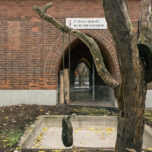
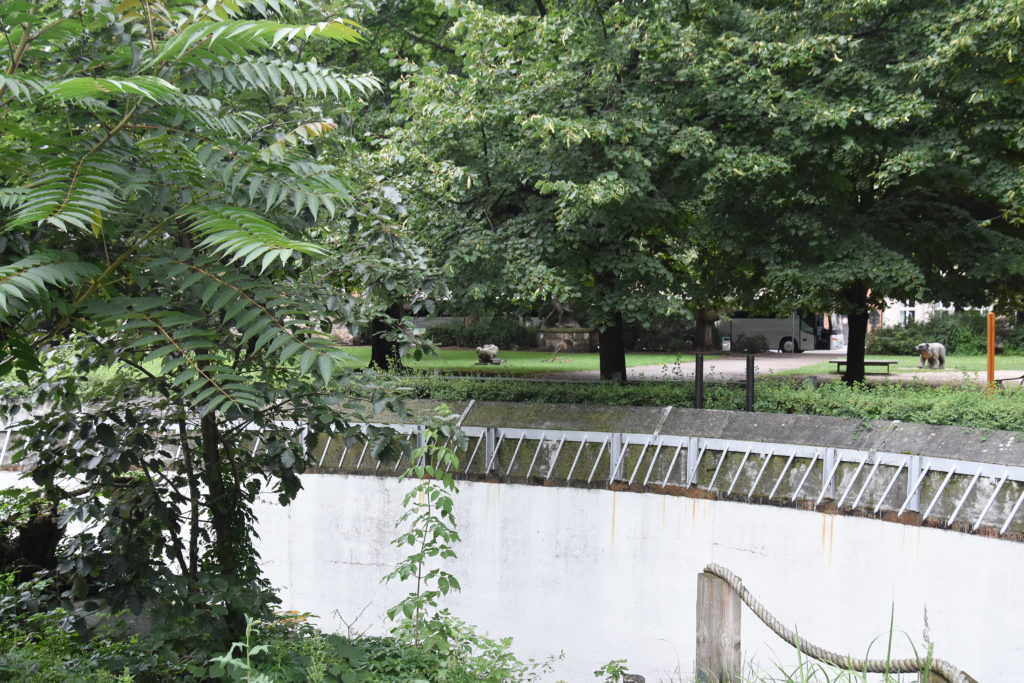
Paradigmatic for zoo architecture the structure of the Bärenzwinger (bear pit) provides a rigid separation between human and animal areas. As the first exhibition within the thematic frame of “Architectures of Segregation”, “Habitat” seeks to undermine these boundaries by means of two different artistic strategies that create new space for interpretation and experience.

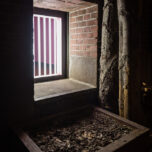
Miriam Jonas, whose works often move between the poles of perfect surfaces and their immanent, covered uncanny effects, overlays the bear cages with a new layer of material. Hybrid visual references form a scenario in which an anthropomorphisation is taken literally and the formal species-neutrality of the prison architecture becomes tangible. What is the effect of an optimization of the conditions within the cages while maintaining functionality?

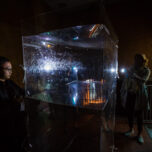
The examination of growth, identity and transformation of living beings are central to Andreas Greiner‘s artistic practice. Inside the Bärenzwinger, bioluminescent algae find their habitat within the architectural limitations of a sculpture. Their glow in a dark room mentally leads us back to the origins of all life. In the outdoor enclosures, a biotope for algae is forming – a project with architect Ivy Lee Fiebig, who enters into a symbiosis with the algal bloom in the creation of a biological cycle on-site. While algae already provide new solutions within the fields of industry and research, Fiebig herself is working on modular designs for living architecture.

Curated by
Nadia Pilchowski and
Marie-Christin Lender

Miriam Jonas

Miriam Jonas (*1981)
studied under Ayse Erkmen and Katharina Fritsch at the Münster Academy of Fine Arts, where she herself has taught since 2017. Prior to her studies, she received classical and technical training in scenography and sculpting at the Bonn Opera House.

Her site-specific sculptures and installations are formed mostly in direct confrontation with the circumstances of a given space and its characteristic elements.

Often they serve to comment on the existing and thus manifest in the most diverse forms, colors and materiality. We find the common thread in the material presence, while traces of the craftwork itself remain barely detectable. As an artist and craftswoman, Jonas consciously drifts into the background, bringing her works to the fore, opening up a vista to a particular, perplexing clarity.

In addition to a solo exhibition at the Greven Kunstverein, her works have been exhibited at Bar Barbette; Galerie Russi Klenner, the Dahlem Kunsthaus; Eigen+Art Lab and Kwadrat.

Andreas Greiner

Andreas Greiner (*1979) studied art and medicine at the Technical University of Dresden, the Academy of the Arts in Dresden and the UDK Berlin, among others. In 2012, he completed his MA under Olafur Eliasson at theInstitut für Raumexperimente.

Greiner operates at the interface between art and science, while confronting the reality of the consumer society.

In 2016, he was awarded the GASAG Art Prize for his exhibition “Agentur des Exponenten” at Berlinische Galerie, for which he developed a skeleton of a broiler chicken using 3D print technology, which serves as a monument to the genus.

Last year, his works were exhibited at the Arnsberg Kunstverein (Arnsberg Art Association), Hamburger Bahnhof (as part of the Festival of Future Nows), the Sprengel Museum Hannover, Galerie Dittrich und Schlechtriem in Berlin, the Krefeld Kunstverein (Krefeld Art Association) and the nbk in Berlin. Internationally, he has exhibited in Denmark, Korea and the United States.

With kind support from the interdisciplinary funding and exhibition funds of the Senate Administration for Culture and Europe as well as from “innogy Stiftung für Energie und Gesellschaft gGmbH”.

Performances

Sat 04/28/2018
3-5pm

“Koke no Ori”
by Setu

Moss with its velvety, even surface captivates with contentment and elegance. The simple beauty of Japanese moss gardens, as they are created for example in Zen Buddhist monasteries and here by the Japanese architect-artist duo Setu, consisting of Akihiro Yamamoto and Takafumi Tsukamoto, are founded in deep respect for the fine soil plant.

Striving not only for an aesthetic sense, the delicate moss that grows on the walls and between the iron bars separating the outer enclosure at Bärenzwinger, gets protected from humans, animals and dry weather and find a new optimised habitat.


“Water is heavy”
by Ivy Lee Fiebig

Within the outdoor enclosures, Ivy Lee Fiebig has been creating a biotope for algae and entered with the start of the exhibition into a symbiosis with the algae bloom, testing a biological cycle within a closed unit.
A bicycle-powered pump provides the exchange between the various organic and inorganic entities, which find themselves in continuous transformation.

In a race for the maintenance of vital conditions, the bicycle is operated to potentiate the growth of algae, thereby accelerating the process of photosynthesis and the production of energy, nutrition as well as purifying drinking water. The goal of this architectural design of an artificially produced one-woman-biosphere is to achieve equilibrium between the human, the environment and the all other living beings which inhabit it.

With kind support from the interdisciplinary funding and exhibition funds of the Senate Administration for Culture and Europe as well as from “innogy Stiftung für Energie und Gesellschaft gGmbH”.

Hibernation

Linda Kuhn and
Alvaro Urbano

Robert Eckstein [Photography]

Opening
01/19/2018, 7pm

Welcome
Sabine Weißler,

District Councillor for Education, Culture, Environment, Nature, Street and Green Areas

About the exhibition
Julia Heunemann
and Nadia Pilchowski

Duration of the exhibition
01/20/2018 – 03/10/2018

Accompanying program

Sun 03/04/2018 at 3pm
›Maloota‹ – Performance by Michel Voolta


During hibernation, the Berlin city bears were rarely seen in their outdoor enclosures. They mostly slept, were fed only inside the bear pit out of public view, and freed from their representative role. Periods of rest in which physiological processes shut down, mental tension subsides and where consciousness shifts between vague perception and purposeless actions, are disharmonious with neoliberal performance orientation.

“Hibernation” presents artistic positions which examine those conditions and effects of temporary withdrawal.

In her previous works, Linda Kuhn has addressed the withdrawal from goal-orientated action. In the outdoor enclosures of the bear pit, which align physical distance with comprehensive visibility, the Berlin-based artist obstructs the visitors’ views. With protective cladding for sculptures, she creates retreats for the elements found within the enclosures, and in the process, ascribes to them new plastic qualities.

By means of architectural interventions that circumvent habitual perceptual patterns, Alvaro Urbano deconstructs relations between inside and outside, dream and reality. Considering hibernation, he suspends the bear cages from their intended use and focuses on the imaginary potential of their immured and barred architecture. The question then of what bears dream about ultimately reflects hibernation itself as a space of the imaginary.

Curated by
Julia Heunemann
and Nadia Pilchowski

Linda Kuhn

The works of Linda Kuhn focus on the possibility of withdrawing from common work and time structures. Sculpturally, she examines current leisure habits and questions how physical activities are reproduced in this context.

Born 1983 in Berlin, Linda Kuhn has exhibited her works in Berlin (SOS, Luftraum, Humboldt Carré, Kunstquartier Bethanien), London (Oxo Tower, Triangle Space) and Vienna (Kunsthalle Exnergasse) in recent years.

In 2015, she received the Goldrausch Scholarship (Berlin), and last year was invited to attend the Leisure Studies Association Conference in Leeds, UK.

Alvaro Urbano

Alvaro Urbano, born 1983 in Madrid, Spain, lives and works in Berlin. He studied at the Architecture School in Madrid and completed his Master Studies at the Institut für Raumexperimente, Olafur Eliasson Class, Universität der Künste, Berlin. In 2014 Urbano received the Villa Romana Fellowship. He attended the The Artists and Architects-in-Residence at MAK, Los Angeles, 2016/2017.

Solo projects include: Altbau, ChertLüdde, Berlin, 2017; Almost Midnight, Frankfurt am Main, Berlin, 2017; Assemble, performance night, Bundeskunsthalle, Bonn, 2017; I, Mole Antonelliana, Turin, in collaboration with The National Cinema Museum of Turin, 2016.

Group exhibitions include: Alpina Huus, Geneva and Lausanne, 2017; Festival of Future Nows II, Hamburger Bahnhof, Berlin, 2017; Notes on our equilibrium, CAB, Brussels, 2017; That Time, Cycle Music and Art Festival, Iceland; Deep Inside, Moscow International Biennale for Young Art, Moscow, 2016; Art and Nature: Walking with Senses, Merano, 2016.

Performance

›Maloota‹ by Michel Voolta

Sun 03/04/2018 at 3pm
Köllnischer Park

Since 2010, the artist group Michel Voolta has been working mainly with video and performance. Last year they worked in the format of a choir. Michel Voolta’s record ›Aber jetzt… denn Lieder bewirken viel‹ will be released on Smareazy in March 2018.

The name ›Berlin‹ stems from Slavic ›br’lo‹, meaning marsh. The Berlin Baer is a so-called ›speaking crest‹, which tries to produce the sound of a symbol in the German language. Symbols on shields [to protect against attacks] were initially personal. Over time, they became hereditary and transferred from one generation to the next. After the emergence of stronger armor with face covering they served the recognition of the knights in the war turmoil. This military function then disappeared again with the advent of firearms [i.e. fighting over long distances], the coat of arms became a pure object of symbolism.

Thus, the private person does not appear, as if he/she did not exist at all. And what did the servants wear?

›The lacing of the doublet is clear. Buttons were banned for workers in the middle ages, so lacing was the tradition among the lower classes long after the law had passed into history. To let the lining of the knee breeches show had been the fashion in 1666, but here it is still being worn in the 1690s. A few buttons on the sleeve, however, show a slow trend towards aping the aristocracy‹

[Diana de Marley, Working Dress – A History of Occupational Clothing, London, 1986]

Fur Agency

NEOZOON

Tobias Willmann [Photography]

Opening
11/10/2017, 7pm

Duration of the exhibition 

11/11/2017 – 01/05/2018

Welcome
Dr. Ute Müller-Tischler, Head of Department Arts and Culture

About the exhibition
Anne Hölck and Sebastian Häger

Accompanying program

Sat 12/02/2017 at 2pm
Exhibition Tour with curator Anne Hölck

Sun 12/10/2017 11am-2pm
Workshop ›How bears are living‹ with Anne Hölck, Marcela Moraga and Sebastian Häger

Fr 01/05/2017, 6pm
Finissage with Sound-Performance by Native Instrument

After the first exhibition project “Ursus Olfaciens” visited the traces left behind by the Berlin bears at the Bärenzwinger, follows a critical inquiry into how humans view animals.

The starting point for the exhibition “Fur Agency” focuses on animal fur as an effective actor, in how it provokes reactions in its viewers. Fur evokes a feeling of warmth and comfort, the desire to look at it or touch it. The “incumbent” Berlin city bears were also subjected to this romanticized view.

“In principle, each cage is a framework around the animal”, writes John Berger in 1980 in “Why Look at Animals?”. The animal becomes an image in the zoo which we can view. We feel close to it, but at the same time it is alien to us. It is its otherness that particularly fascinates us. Nowhere else is that so apparent than in the zoo, where humans – despite also being mammals that are part of nature – exhibit and view animals as museum objects.

“Fur Agency” not only thematizes this way of keeping animals, but attempts to challenge established habits through an artistic lens. On these grounds, the female artist collective NEOZOON develops the three-part, multimedia installation “Bearly Legal” for the Bärenzwinger.

Curated by Sebastian Häger and Anne Hölck

NEOZOON

NEOZOON is a female artist collective that was founded in Berlin and Paris in 2009. The group focuses on human-animal relationships and examines the treatment of living and dead animals in modern societies. NEOZOON’s art actions take place in public space – on city streets, in public institutions and on the Internet. Their artistic medium encompasses collages, installations and videos.

In their films they address contradictions in language and action that exist in the daily handling of animals, as well as the medialization of these practices.


Current exhibitions and screenings 2016 (selection): SITUATIONS/Filter, FotomuseumWinterthur; Unter Waffen. Fire and Forget 2, MAK, Frankfurt; Anthology Film Archives, New York; Crashed Net Aesthetics, HeK, Basel; Animal Lovers, nGbK Berlin. 2017: The Hobbyist, Fotomuseum Winterthur (CH); Goethe Institut Toronto, Emerging Artists (CAN); HMKV Dortmund, Video of the Month (D); Filmwinter, Stuttgart (D).

Exhibition Tour

Saturday, 12/02/2017, 2-3pm

The guest curator Anne Hölck will guide through the exhibition and i.a. discuss questions about the display of animals in captivity and the architecture of enclosures along the work of NEOZOON.

The free guided tour is offered in German. The meeting point for the tour is the entrance area of the Bärenzwinger.

Please register briefly: info@baerenzwinger.berlin

Anne Hölck, *1970 in Kiel, Germany, is a scenographer and lives in Berlin. Besides her theater work she realizes exhibition projects, project seminars and lectures in the field of Human-Animal Studies with an emphasis on spatial and artistic research. Since 2014 she curates the exhibition series »we, animals. artistic positions on human-animal relations« at Meinblau project space Berlin.

Workshop

Sunday, 12/10/2017
11am-2pm

›How bears are living‹
with Anne Hölck, Marcela Moraga and Sebastian Häger

The admission free workshop is limited to 10-15 participants and is offered in German. Participants should be at least 14 years old. 

Please register briefly: info@baerenzwinger.berlin


The workshop deals with the “living situation” of bears at zoos. After a guided tour through the exhibition of NEOZOON which reflects the human’s view of (zoo) bears, as well as an introduction to the “living” of zoo animals according to the zoologist Heini Hediger, we investigate the living conditions at Bärenzwinger.

In distributed roles, we take different perspectives in order to open up to ethical issues through this experiment and to explore new perspectives on human-animal relations.

Finissage

Friday, 01/05/2017, 6-9pm

Finissage with Sound-Performance by Native Instrument [Stine Janvin und Felicity Mangan]

Native Instrument is a Berlin based sound collaboration bringing together the field-recordings archive of Felicity Mangan and the abstract vocabulary of Stine Janvin Motland. Stine Janvin explores and challenges the physical features of the voice, the acoustics of her surroundings and new performance strategies.

Often referred to as insect techno, Native Instrument’s music is constructed using electronic and vocal adaptations of wildlife audio recordings originating mainly from the Australian and North European fauna; mixing the natural rhythms of animal calls with digital effects and vocal imitations, Native Instrument enlightens a sonic ambiguity between rural nature, electronics, and the human voice.

Native Instrument performed at festivals and venues such as Atonal Berlin; Ope3ra Festival, Mexico City; CTM, Berlin; Rokolectiv Festival, Bucharest; Praha, Brno; Stadtgalerie Bern, Bern; Cave 12, Geneva.

Ursus Olfaciens

Reto Pulfer and
Sarah Ancelle Schönfeld

Bärenzwinger Berlin [BA Mitte]

Opening
09/12/2017, 6 pm

Welcome
Sabine Weißler, Bezirksstadträtin für Weiterbildung, Kultur, Umwelt, Natur, Straßen und Grünflächen

About the exhibition
Nadia Pilchowski and Julia Heunemann

Live Performance
by Eisklares Echo [Mia von Matt and Reto Pulfer]

Opening
09/12/2017, 6 pm

Welcome
Sabine Weißler, Bezirksstadträtin für Weiterbildung, Kultur, Umwelt, Natur, Straßen und Grünflächen

About the exhibition
Nadia Pilchowski and Julia Heunemann

Live Performance
by Eisklares Echo [Mia von Matt and Reto Pulfer]

Duration of the exhibition:
09/13 – 10/29/2017

Accompanying program:

Saturday 09/16/2017
3.30pm
Performance by Sarah Ancelle Schönfeld
Sauna infusion and herbal tea: fig/linden

Sunday 10/29/2017
11am – 7pm
“Fountain of Liver Tea”
Performance by PPKK
(Schönfeld & Scoufaras)

With a double exhibition by Reto Pulfer and Sarah Ancelle Schönfeld, the Bärenzwinger opens as a new exhibition venue in Berlin-Mitte. Side by side, the artists of the site’s debut exhibition search for traces within this historical site: which are visible, smellable, audible, imaginable, perceptible, since the last bear, Schnute, died almost two years ago, leaving an animal-human absence in the bear pit?

The exhibition title points to the perhaps most transient of traces that can be experienced on-site. For Ursus Olfaciens, this means the scent left by the bear and the belonging sense of presence after its death, and at the same time, plays on the animal’s pronounced sense of smell – likely a constant confirmation of human presence.

The cooled, abandoned rooms are heated. Sarah Ancelle Schönfeld, known for her work with alchemical processes, transforms the site into a sauna by means of a heated oven made from found stones which open wide the pores of the old masonry, the iron grating and steel doors of which bring to mind a small, cramped fortress. Within the pit, paralysis and numbness can dissolve, be set in motion, transform, detoxify. Schönfeld brews a site-specific sauna infusion and tea with herbs and berries picked from the vegetation-rife outdoor enclosure, as well as from the surrounding park, which visitors can imperceptibly absorb, experiencing the essence of the bear pit.  Newly constructed connections to the water system of the bear pit, through to the guard rooms, the drinking troughs of the bear cages, the water basins and the trenches of the enclosures, create an experimental well.

Reto Pulfer covers the skylight in the central space of the bear pit with a transparent textile in green and blue hues. The patchwork of fabric shows a map of Bern, birthplace of the artist and origin of Urs and Vreni – a gift from the city and the first pair of bears to inhabit Berlin’s bear pit.

At the same time, the cloth can be read as an astronomical map of the galaxies in the constellation of Ursa Major. It engulfs the room with an intimate green-blue light, the view is steered into the interior of the bear cages and into the guard rooms. Straws on the floor, dust and cobwebs on the walls and bars, scratches on doors and hatches, bite marks in the wood, a calendar hanging on the wall left from 2015, a defunct phone – can all be observed in the rooms with a flashlight. Visitors will also stumble upon a transparent object, roughly the size of an adult brown bear, around which no-one can pass.

In a space once used as a broom cupboard, an installation unfolds that combines fragments from Pulfer’s work: enveloped by an expansive, immersive painting, traditionally knotted ropes suspend self-built instruments, raku ceramics, power cables found on-site and nettle roots dug up from the right outdoor enclosure. This rhizomatic state is captured onto a small-scale painting. In the left outdoor enclosure, Pulfer allows more space for growing.

The resonance of a gong sounds farewell and new beginnings. For the exhibition opening’s “Eisklares Echo” concert (Pulfer / von Matt), the music and clamor of the iron grating conveys the traces of the bears.
 
Curated by Nadia Pilchowski und Julia Heunemann

Sarah Ancelle Schönfeld

Sarah Ancelle Schönfeld (*1979 in Berlin) completed her studies in fine arts at Berlin University of the Arts in 2006. In her works, she reflects forms of the emergence of knowledge, power and truth. It incorporates methods from natural sciences, religion, archaeology or alchemy and implements them in various media such as photography, print, sculpture, installation or performance. 
Her works have been shown at numerous solo and group exhibitions, including the Gildar Gallery (Denver, USA), Aether Project Space (Sofia, Bulgaria); Zabriskie Point Geneva; Galleria Marso (Mexico City) and Goethe Institute (St. Petersburg), as well as in Hamburg’s Kunsthalle, Hamburger Bahnhof (Berlin); Fotomuseum Winterthur in Switzerland and Muzeum Ludwig in Budapest.

Schönfeld was granted a travel scholarship by the DAAD in 2005 and 2008, resident at Villa Aurora Los Angeles in 2011 and received the FOAM Talents Award of the Fotomuseum, Amsterdam in 2014. She lives and works in Berlin.

Together with Louis-Philippe Scoufaras (*1981, Montreal) Sarah Schönfeld formed the duo PPKK, founded in 2016. The duo see their collaboration as an informal nomadic lab which seeks to extract sources and meanings of specific contexts.

Reto Pulfer

Reto Pulfer (*1981 in Berne) grew up in Arlesheim, Baselland and lives in Berlin. His space-filling, immersive installations from fabrics and found materials continue in performances, novels, music and painting. Since 2012, he has accompanied Mia von Matt under the name Eisklares Echo with improvised and music performances lasting several hours. In 2017, his monograph Zustandskatalog: “Catalog of States and Conditions” was published by Sternberg Press and featured at five individual exhibitions in 2015-2016, including: Center d’Art Contemporain Genève; Musée régional d’art contemporain Occitanie / Pyrénées-Méditerrannée, Sérignan; Spike Island, Bristol; Center international d’art et du paysage de l’île de Vassivière; Fórum Eugénio de Almeida, Évora.

Eisklares Echo is the collaboration of Mia von Matt and Reto Pulfer. The music performances by EE are attempts in transformation and rely on the intimacy of improvised timing. With synthesizer, electric guitar, kalimba, electronics, words and effects the duo creates extended, powerful soundscapes embedded in minimal visual magic. They formed in 2012 and played at galleries and clubs like Dingum, Berlin, Haus der Kulturen der Welt, Berlin; Swiss Institute, New York; Kosmos Theater, Vienna; Acud, Berlin.

Fountain of Liver Tea

Sunday 10/29/2017
11am – 7pm
Performance by PPKK
(Schönfeld & Scoufaras)

PPKK is a casual nomadic lab founded by Sarah Ancelle Schönfeld and Louis-Philippe Scoufaras, in the pursuit of analyzing and reflecting upon specific (local) contexts, generating mythological and technological outputs in order to shift perspectives and enable new interpretations. PPKK is excited to transform the former bear kennel into a fully functional steam sauna.


“The Fountain of Liver Tea” serves as the heart of this one day performance: a device created from a hacked washing machine that automatically produces a herbal infusion and subsequently spits it onto the heated rocks for aromatic steam and pours it into the visitors’ cups for simultaneous ingestion. The herbs that spin in the machine were hand-picked on the terrain of the Bärenzwinger and contain a controlled combination of various healing properties based on herbalistic studies. The heated stones were also found in the urban surroundings of the compound. The presence of humans in a state of relaxation in the heated and humidified architecture with recalibrating steam and sounds of the sequential spinning cycles will cathartically sedate the melancholia that floats in what used to be a bear prison.

This event is free of charge and the participation in “The Fountain of Liver Tea” is limited to 10 visitors per time slot. Each slot extends over a period of two hours (11am-1pm; 1-3pm; 3-5pm; 5-7pm.)

Please pick a precise hour of our time-table at which you punctually appear and register RSVP ASAP by sending an E-Mail to fountainoflivertea@
baerenzwinger.berlin.

After successful registration you are required to bring your own towels, slippers, toiletries and bathing suit.

Kindly note that on October 29th the Bärenzwinger is only accessible for registered guests of the performance. For conservational reasons Reto Pulfer’s works in the exhibition are on view only until 28.10.2017.

Curated by Nadia Pilchowski and Julia Heunemann