Swinger

Kerstin Honeit und
Pätzug / Hertweck
Opening

05/18/2018 at 7pm

Welcome
Dr. Ute Müller-Tischler
Head of Department Arts and Culture

Introduction to the exhibition
by the visiting curators
Stefan Aue, Anne Hölck and Jessica Páez

Duration of the exhibition
05/19/2018 – 07/01/2018

Accompanying program

Sun 06/10/2018
Curatorial tour through the exhibition

Fri 06/29/2018, 7pm
Finissage with Lecture Performance by Prof. Dr. Stefanie Wenner and music by Frinda di Lanco

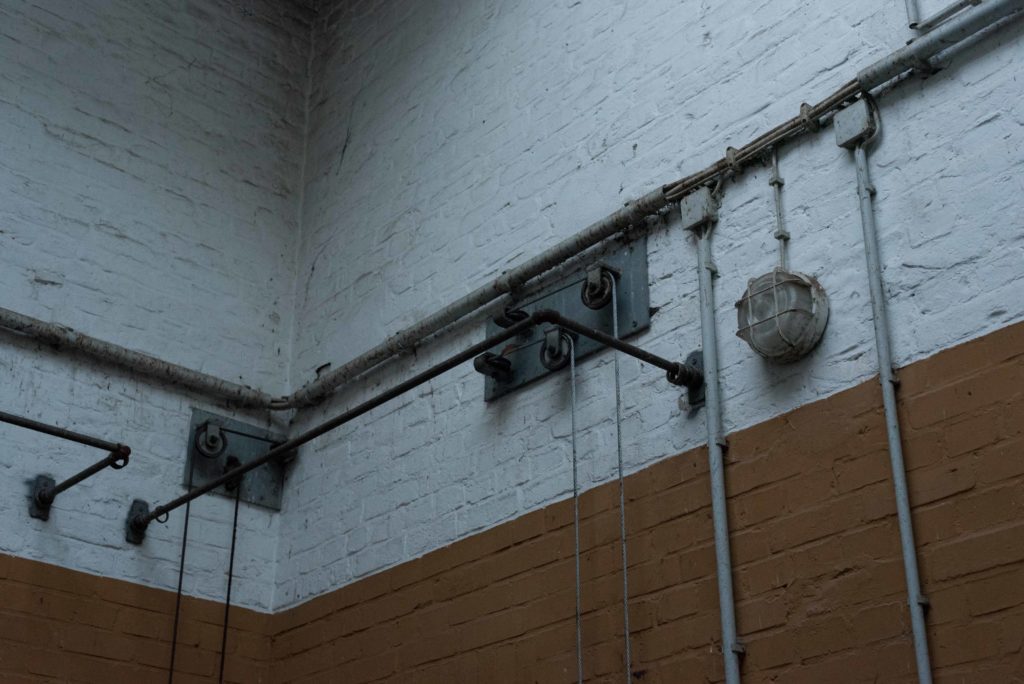
The architecture of the Bärenzwinger constructs a specific reality: Movements and encounters between bears and humans were regulated through perfect mechanisms: Security grating systems determined the animals’ path, and keepers would operate them, thus maintaining the scenery in the

outdoor enclosures for the visitors’ view.

Today, these systems form the backdrop for another staging of movement and a new choreography of encounter.

To what extent does architecture structure the relationship between humans, animals and objects? How is behavior shaped by spacial structures, and how can these established conditions be disrupted and re-negotiated?

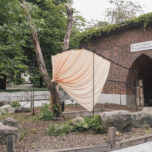
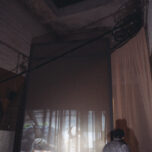
In the exhibition “Swinger”, former demarcations are revised. The mechanically animated installation “Pagodenwackeln” by Pätzug / Hertweck moves throughout the interior and exterior of the Bärenzwinger and challenges a positioning in relation to the space and its voids.

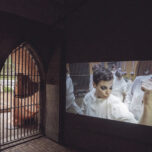
In Kerstin Honeit’s Video work “Panda Moonwalk or Why Meng Meng Walks Backwards”, human and inhuman bodies actively and resistantly assert themselves in the context of social injustices.

The works touch, overlap, interrupt each other and outline modifiable structures, so that the Bärenzwinger’s construction of eality collapses and can be re-interpreted in a never-completing loop.

Curated by Stefan Aue, Anne Hölck and Jessica Páez

Kerstin Honeit

Using video works, performance and installations in her artistic research, Kerstin Honeit examines worlds of hegemonic image production in the media of information technology and pop culture. Intervening at the boundaries of representation and reception, she questions the construction of social norms.

Pätzug / Hertweck

Irene Pätzug and Valentin Hertweck have been collaborating since 2012 on largescale installations that employ kinetic elements to address space as a medium.

Their work interrogates the relationship between space and human, their collaborative practice is rooted in the conception that space itself is an actant, and not only the humans populating it. Their work evolves from an intensive engagement with the given architectural conditions of the exhibition space and transforms it into a backdrop, stage or display in combination with movement, action and reaction.

Visiting Curators

We are excited to have Stefan Aue, Anne Hölck and Jessica Páez as visiting curators for the fifth exhibition project at Bärenzwinger.

Stefan Aue concieves and realizes thematic projects between science and art, currently he works at Haus der Kulturen der Welt (HKW) in Berlin. Anne Hölck is an independent scenographer for theatre projects and curator in the field of human-animal studies. Jessica Páez is an independent producer and dramaturg in theatre and visual art and works as a project coordinator at Haus der Kulturen der Welt (HKW) since 2015. Their common interest in the artistic production of knowledge and its presentation combines them as curatorial team.

Lecture Performance

Friday, 06/29/18, 7pm

Finissage of the exhibition ›Swinger‹

with Lecture Performance
by Prof. Dr. Stefanie Wenner


and afterwards music
by Frinda di Lanco


Against Aboutness oder: “How not to speak”

The anthropologist Martin Holbraad asked, “Can the thing speak?” thereby triggering the never-ending sequence of essays which in the tradition of Spivaks addressed the question of whether the subaltern could speak. Politics in art looks often enough at precisely articulating that which fails to be addressed in hegemonic speech. But what if language were not the appropriate medium, not even scientific language, but poetry at most? What if language itself is the problem, the wanted culprit that can only be tackled by saying that which cannot be declared via language? If something isn’t about something, but with something?

Stefanie Wenner is Professor of Applied Theater Studies at the HfBK Dresden and works on better representations of reality.

Grabenblicke

Alex Lebus, Katharina Bévand, Lawrence Power und Marten Schech

Tobias Willmann [Photography]

Opening
07/12/18 at 7pm

Welcome
Sabine Weißler
District Councillor for Education, Culture, Environment, Nature, Streets and Green Areas, Bezirksamt Mitte von Berlin

About the exhibition
Julia Heunemann

Performance
itinerant interlude #22
Adam Goodwin, double bass
Michiyasu Furutani, dance

Duration of the exhibition
07/13/18 – 08/26/18

Manu Bruckstein [Camera and Editing]

Reflecting the spacial infrastructure in and around the Bärenzwinger, the exhibition “Grabenblicke” explores site-specific dispositives of gaze and their effects on the relationships between identity and
alterity.

The view into the outdoor enclosures must clear a fence, a hedge, a wall, metal shark-tooth spikes, trenches and a wooden barrier. Behind these confining architectural elements the view eventually encounters itself: by means of modified mirrors, the expansive installation by Alex Lebus disrupts the architectural assignment of subject and object relations and unsettles the viewers’ position.

In the opposite enclosure the gaze
falls upon a house, whose context,
function and origin remains unclear, and that seems strangely
out of place. With his work,
Marten Schech transforms the artificial habitat once set up for the bears, including the boulders
placed around the site, into both
a stage and building material.

The interior of the Bärenzwinger
was long kept out of public view.
In the anteroom, Lawrence Power unlocks the functional infrastructures already partly obsolete, lending pictorial expression. By duplicating and extending the present elements, he interprets the space itself as a canvas.

Via auditory means, Katharina Bévand‘s sound installation ultimately surveys the architecture of the darkened Zwinger space and the cavities located opposite. Its sounds reflect from walls, ceilings and security grates – penetrating the segregating architectures at the same time.

Curated by Sebastian Häger
and Julia Heunemann

Katharina Bévand

Katharina Bévand is a sound artist currently based in Berlin. After studying Fine Arts at universities in Spain, South Korea and Brazil, she completed her MA in Sound Studies at the University of Arts in Berlin. In 2017 she received an honorary mention at “sonotopia-bonn hoeren” of the Beethoven Foundation for Art and Culture Bonn.

Her artistic practice oscillates between performative and installative soundworks, which explore the acoustics of architectures, objects and the human body. Her sound installations and performances have been presented in numerous extraordinary spaces such as the former water reservoir “Wasserspeicher” in Berlin, the Museum of Islamic Art (Pergamonmuseum) in Berlin, the former crematory at Südstern (Berlin), the old hammam of the citadel in Erbil in the Kurdistan Region of Iraq, and the Sudhaus of the Kindl-Brewery in Berlin.

Alex Lebus

In her artistic approach, Alex Lebus (*1980) repeatedly utilizes mirrors to create reflections, duplications and flashbacks, to unmask and question what is evident and to consistently examine the relations between appearance and reality, fact and fiction. Lebus lives and works in Berlin and studied Fine Arts at the HfBK in Dresden, completing her MA under Prof. Eberhard Bosslet.

She has participated in numerous solo and group exhibitions at Kunstraum Potsdam, Galerie EIGEN + ART Leipzig/Berlin, EIGEN + ART Lab, the Dresden City Art Gallery and PING PONG Basel, among others. She is represented by the EIGEN + ART Lab, Berlin. Alongside a Hegenbarth grant and an artist residency at Axel Springer Plug and Play Accelerator (Berlin) she completed a scholarship from the Manchester School of Art (UK) and Konrad Adenauer Foundation (Berlin). In 2019 she will attend an artist residency at the KKV Grafikverkstad Malmö, Sweden.

Lawrence Power

Lawrence Power (*1982) studied under Norbert Schwontkowski and Anselm Reyle at the HFBK Hamburg as well as the Université du Québec à Montréal (Canada). His solo exhibitions have featured at Balzer Projects (Basel), Pablo’s Birthday (New York City), Emmanuel Post (Berlin) as well as in Hamburg at the Diane Kruse Galerie and Galerie Tinderbox, among others.

Power has also participated in numerous group exhibitions, including: Laden für Nichts (Leipzig), Galerie Kai Erdmann (Hamburg), Kleine Gesellschaft für Kunst (Hamburg), Galerie Toolbox (Berlin), at Jahn und Jahn (München), Carico Massimo (Livorno, Italien) and at the Kunsthaus Hamburg. He has received scholarships and awards from the Künstlerhaus Schloss Wiepersdorf, the Ditze-Foundation Hamburg and the New Brunswick Art Board (Canada).

Marten Schech

Marten Schech (*1983) studied at the HfBK in Dresden, under Prof. Franka Hörnschemeyer in Düsseldorf, at the University of Leeds (GB) and completed his MA under Prof. Wilhelm Mundt. He lives between Dresden and Berlin and is represented by Galerie Bernhard Kanus Fine Art, Frankfurt/Main.

His solo shows have featured in the Hans Körnig Museum in Dresden, at Kabakon, Leipzig, and he has been represented by the Förderverein Aktuelle Kunst (FAK) at the Institute of Art History, Münster. Schech has also participated in numerous group exhibitions, most recently at Kunstverein Hamburg, Kunstpalais Erlangen, Kunstverein Familie Montez (Frankfurt am Main), the European Centre of the Arts, Hellerau, the Museum of Contemporary Art (MWW) Warsaw (Poland) and at L’Amour, Paris (France), among others. In 2014 he was nominated for the Boesner Art Award, completed a scholarship from the German National Academic Foundation and received the Caspar-David-Friedrich-Preis as well as the Marion Ermer Award.

itinerant interludes is curated by  Laurie Schwartz and funded by initiative neue musik.