Intimate Matter

Marlene Zoë Burz
Lisa Premke
David Reiber Otálora

[Foto] Marlene Burz

Opening
08/08/2019 7pm

Exhibition
08/09 – 10/27/2019

08/17/2019 7 – 10 pm
80 Years Bärenzwinger

08/31 + 09/01/2019
Architecture and Art Weekend

09/06/2019 7 – 10 pm
Presentation by Hopscotch Reading Room

09/08/2019 11 am – 7 pm
Tag des offenen Denkmals

10/06 + 10/12/2019 2 – 4 pm
eWalks with Karl Heinz Jeron

10/23/2019 7 – 10 pm
TheorieMittwoch

Our entire living reality is determined by a large number of economic, ecological, political, and social structures. When we order these often irrefutable-seeming givens and the objects surrounding us, we construct systems of interpretation to organize and make intelligible the complex conditions in which we live. These systems are thus both orientation and security, in that resorting to familiar patterns of thought and perception is always an act of self-reassurance. 

But what happens when this familiarity with the seemingly everyday things surrounding us suddenly eludes us, when semantics shift, overlap, and create new orders, when we begin to doubt our customary mechanisms of interpretation and classification? 

The exhibition »Intimate Matter« with the artists Marlene Zoë Burz, Lisa Premke, and David Reiber Otálora hovers imperceptibly on the borders of perception, creates intimate moments of discomfiture, and seeks to make visible the delicate boundary between what we know and don’t know. The exhibited works play with the destabilization and recontextualization of objects and materials.

The mutability and negotiability of the meanings we create becomes apparent when matter – the objects in space – cast off their intended mode of functioning and lay claim to a new, individual form of reality. Familiar relationships between individual objects and their viewers are reconsidered and brought into a different context. And if we allow it, this harbors the potential to rethink our relationship to our surroundings and our supposed certainty over what we believe we know – and to see it in a new way. 

Exhibition & events curated by
Ulrike Riebel and Nandita Vasanta
Jan Tappe and Hauke Zießler

Graphic Design: Viktor Schmidt
Translation: Andrea Scrima
Production: Carolina Redondo
Production Assistance: Felipe Monroy

Download Concept

Marlene Zoë Burz

Marlene Zoë Burz, geboren 1990 in Stuttgart, studierte von 2010-2015 an der Kunsthochschule Berlin Weißensee bei Prof. Hanns Schimansky. 2016 war sie Meisterschülerin bei Prof. Friederike Feldmann. Seit 2016 organisiert und kuratiert sie zusammen mit Manuel Kirsch und Björn Streeck den Projektraum SOX auf der Oranienstraße 175 in Berlin. Ihre Arbeiten wurden u.a. in Toronto, Bregenz, Bern, Bonn und Berlin gezeigt. Sie lebt und arbeitet in Berlin.

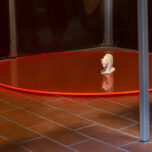
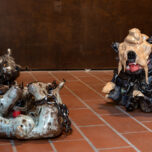
Als geradezu fremdvertrautes Schriftbild muten die Formen an, die die Künstlerin Marlene Zoë Burz auf das den Hauptraum des Bärenzwingers umlaufende Banner gezeichnet hat. Doch so sehr wir auch versuchen, die Zeichen unseren Sehgewohnheiten entsprechend in eine uns bekannte Lesbarkeit zu überführen, bleibt diese uns doch weitestgehend verschlossen. Erst auf den zweiten Blick lassen sich die zufällig angeordneten Formen als schablonenhafte Abstraktionen von Knochen erahnen. Knochen sind fundamentaler Bestandteil jedes Wirbeltiers, jedes menschlichen Körpers und doch stets unter der Oberfläche verborgen – ein unsichtbarer, geradezu intimer Bereich, der erst durch massive Eingriffe in die körperliche Materie Sichtbarkeit erlangt. Und doch ist ihre Funktion selbst eine schützende, Struktur und Halt gebende. Rekontextualisiert wird diese Ambivalenz in den kapuzenförmigen Objekten im Raum, die auf geradezu surreale Weise in Interaktion mit der Formsprache der Zeichnung treten. Während die Knochen als Form auf Papier überführt werden, beruhen die plastischen Kapuzenobjekte auf zweidimensionalen Schnittmustern. Doch auch in den Kapuzen selbst, zunächst einmal alltägliche Kleidungsstücke, spiegelt sich das doppeldeutige Verhältnis von Form und Oberfläche, Innen und Außen. In ihrer Vergrößerung erwecken sie den Eindruck einer schützenden Verhüllung und werfen dabei doch zugleich zwangsläufig die Frage nach einem Inneren, einer verborgenen Körperlichkeit auf.

Lisa Premke

Lisa Premke, geboren 1981, studierte zuerst Architektur und anschließend Bildende Kunst an der Gerrit Rietveld Academie in Amsterdam bevor sie ihren Master of Sound for the Moving Image an der Glasgow School of Art machte. In ihren Arbeiten sucht Premke nach Spuren kollektiver Systeme in Objekten und Materialien und gibt ihnen eine eigenständige Stimme und Narration. Für ihre ortspezifischen Projekte wurde sie wiederholt zu internationalen Aufenthaltsstipendien, wie der Bangalore Goethe Residency Kochi in Indien, der Košice Artist in Residence (Slowakei) und der Binaural Nodar in Portugal eingeladen. Ihre Arbeiten wurden in zahlreichen Ausstellungen gezeigt, unter anderem in der Kochi Muziris Biennale Pepperhouse Residency in Indien, der Berliner galerie weisser elefant, im Studio 1 Künstlerhaus Bethanien in Berlin und im Arti et Amicitiae in Amsterdam. Als Sound- und Raumdesignerin arbeitet Lisa Premke seit Jahren in Kooperationen mit verschiedenen Künstlern, Filmemachern und Choreographen. 2019 ist die Künstlerin Preisträgerin des Neuköllner Kunstpreises sowie Stipendiatin des Kulturaustauschstipendiums Global des Berliner Senats.

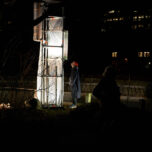
Deutlich sicht- und hörbar hingegen erstreckt sich Lisa Premkes Soundinstallation als symmetrisch angeordnetes Muster über die rechte Außenterrasse des Bärenzwingers. Eine Vielzahl verschiedener Ketten spannt sich über den begrünten Bereich, die Bodenflächen entlang über das Wasserbecken. Die Ketten bewegen sich, angetrieben durch mehrere Motoren, in unregelmäßigen Rhythmen, erzeugen in der Berührung miteinander wie auch mit ihrem Untergrund und dem sie partiell umhüllenden Wasser unterschiedliche Klänge. Im Prozess des Spannens und Entspannens verändern die Ketten ihren Zustand, ihre Dynamik und werden zu bewegten Körpern. Dabei erzeugen die verschiedenen Materialitäten und Stärken der Ketten eine Pluralität an Stimmen, jeweils eigene Narrationen, die sich im Laufe der Zeit durch Reibung und Korrosion verändern. Die akustischen Unregelmäßigkeiten und Variationen im Klang vermitteln den Eindruck eines intentionalen, bewussten Agierens, der Fähigkeit eigenständig zu handeln. Fast scheint es, als wären die zu vernehmenden Klänge ein Akt der Selbstermächtigung, individuelle Stimmen die sich formieren, um den ihnen zugewiesenen Objektstatus ein für alle Mal abzulegen. Die Ketten treten mit ihrer Umgebung, den sie berührenden Materialien in Interaktion, sind aktiver Teil eines Wechselverhältnisses, in dem sie gleichermaßen verändert werden wie auch selbst die umliegende Substanz verändern.

David Reiber Otálora

David Reiber Otálora, geboren 1992 in Münster (Westfalen), wuchs in Kolumbien auf und studiert derzeitig bildende Kunst mit Schwerpunkt Film und Zeitbezogene Medien an der Hochschule für bildende Künste Hamburg. Dort schloß er im Juli 2016 seinen Bachelor ab und begann ab Oktober desselben Jahres sein Masterstudium in den Klassen von Robert Bramkamp, Matt Mullican und Angela Schanelec. In seinen Filmen und bildhauerischen Arbeiten (gelegentlich auch Bühnenbilder) beschäftigt sich David Reiber Otátora mit Exotismen und kolonialen Repräsentationen des Anderen und forscht nach Möglichkeiten, diese als Grundlage fantastischer und doppeldeutiger Narrationen zu affirmieren. Seine Arbeiten wurden bereits in unterschiedlichen nationalen und internationalen Institutionen, Ausstellungsräume und Festivals gezeigt (u.a. in Frankfurt, London, Paris, Bogota, Shanghai).

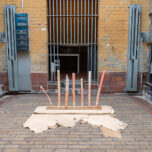
David Reiber Otáloras Installationen erinnern auf den ersten Blick an allgegenwärtige und gerade deshalb oft unbemerkte Elemente in fast jedem Innenraum. Die gefalteten metallenen Objekte sind mit schwarzen, schattenhaften Konturen von Heizkörpern bemalt und erweitern als vermeintlich alltägliche Wärmespender die Räume des Bärenzwingers. Doch werden dabei nicht nur unsere Sehgewohnheiten durch die Übersetzung dreidimensionaler Körper in eine Zweidimensionalität ad absurdum geführt. Auch die uns bekannten Funktionsweisen von Gegenständen werden verkehrt, produzieren die Arbeiten doch nicht selber Wärme, sondern werden vielmehr durch externe Licht- und Wärmequellen erhitzt. Zugleich scheint es fast, als erhielten die gezeichneten Umrisse durch ihre Wärmeempfindlichkeit eine fiktive Körperlichkeit zurück. Ihre punktuelle Erhitzung führt zu einer Veränderung der Oberfläche, lässt die Heizkörperkonturen unsichtbar werden. Zum Vorschein treten versteckte Zeichnungen, die an Höhlenmalereien erinnern. Wie in der Chauvet-Höhle, deren berühmte Höhlenmalereien aufgrund ihrer Lichtempfindlichkeit nur für wenige Sekunden durch den Strahl einer Taschenlampe visuell wahrnehmbar werden, ist auch hier die Sichtbarkeit eine temporäre, die sich mit der Abkühlung der Installation verflüchtigt.

80 Jahre Bärenzwinger

17.08.2019 19 – 22 Uhr
mit Julia Pomeranzewa und Christa Junge

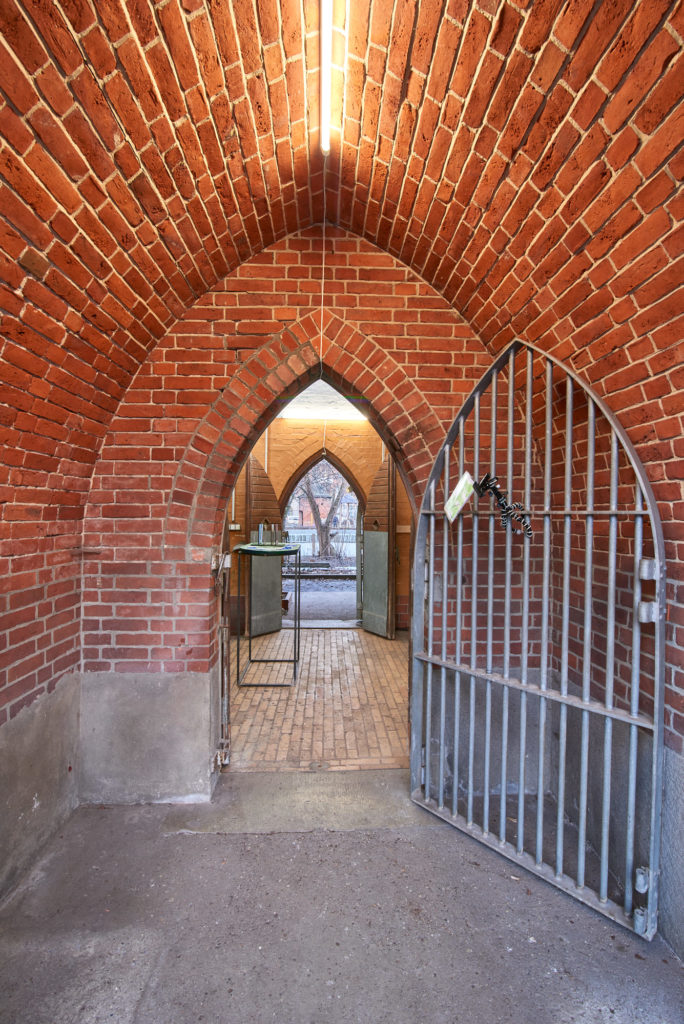
Am 17. August 1939 öffnete der Bärenzwinger im Köllnischen Park seine Pforten, um den Berlinern das lebendige Wappentier ihrer Stadt zu präsentieren. Nach dem Zweiten Weltkrieg lebten im Zwinger seit 1949 über viele Jahre hinweg immer mindestens 2 Bären, bis 2015 die letzte Stadtbärin Schnute verstarb.

Seit September 2017 ist das ehemalige Bärengehege der Berliner Stadtbären als Kulturort für ortsspezifische zeitgenössische Kunst in Berlin-Mitte geöffnet und bietet den Besucher*innen neben dem wechselnden Ausstellungsprogramm auch ganz grundsätzlich die Möglichkeit, sich das ehemalige Domizil der Bären zu besichtigen.Zum Anlass des achtzigjährigen Jubiläums des Geheges veranstaltet der Bärenzwinger ein Abendprogramm, das die Geschichte, Gegenwart und Zukunft vorstellt und bespricht. Gemeinsam mit der Kulturwissenschaftlerin Julia Pomeranzewa und Christa Junge vom Verein Berliner Bärenfreunde e.V. gibt das Team des Bärenzwingers einen Einblick in die gegenwärtige Nutzung des Bärenzwingers, persönliche Perspektiven auf und Erinnerungen an die Bären und die Bedeutung des Zwingers innerhalb der Stadtgeschichte Berlin.

Hopscotch Reading Room

06.09.2019 19 – 22 Uhr Presentation by Hopscotch Reading Room

Die Veranstaltung findet in Englischer Sprache statt.

Hopscotch Reading Room, ein nicht-kommerzieller Buchladen, Lese- und Veranstaltungsort in Berlin ist für einen Abend zu Gast im Bärenzwinger. Wir freuen uns sehr auf diesen Abend mit unserem Gastgeber Siddhartha Lokanandi, Kodwo Eshun und Moses März.

An diesem Abend werden wir mit Kodwo Eshun sprechen, einem Schriftsteller und Denker, der seit langem in die Idee des »Panafrikanismus« – ebenfalls dem Thema seines nächsten Buches – vertieft ist, und sich in diesem Zusammenhang mit der wegweisenden Verlagsreihe »African Writers Series« beschäftigt. Diese Sammlung ist auch eine der Säulen, auf denen die Idee des »Hopscotch Reading Room« ruht. Nun, was ist dieses wundersame Ding, wie sieht es aus, was lehrt es uns?

Wir werden einen Teil unserer Sammlung dieser Bücher zeigen und mit Kodwo über diese Serie, ihre Herkunft, Wirkung und Reichweite, über das Publizieren in den neuen unabhängigen Nationen Afrikas und vieles mehr sprechen. Im Anschluss daran wird Moses März einige der von ihm für die neueste Ausgabe der »Chimurenga Chronic: Die afrikanische Vorstellung von einer grenzenlosen Welt« produzierten Karten vorstellen, zusammen mit den redaktionellen Debatten und dem Forschungsprozess, der sie geprägt hat. Er wird auch darüber sprechen, wie die Gründung von Mittel & Zweck, inspiriert von seiner Zusammenarbeit mit Chimurenga und dem Wunsch, einige seiner Methoden in einen deutschsprachigen Kontext zu übersetzen, erfolgte.

Auf diese Weise versuchen wir, einen Bogen aus den Ideen der »African Writers Series« zu ziehen und wie sie sich in der Gegenwart weiterentwickeln und manifestieren.

EWALKS

06. + 12.10.2019 14 – 16 Uhr
Experimentelle Audiotouren mit Karl Heinz Jeron

Als Teil der aktuellen Ausstellung »Intimate Matter« wird uns Karl Heinz Jeron auf einen eWalk mitnehmen, bei dem die städtische Umgebung des Bärenzwingers erkundet wird. Die eWalks beziehen sich auf das Konzept des Dérive und Détournement. Dérive oder ›streunen‹ bedeutet spazieren gehen und dabei den eigenen emotionalen und psychologischen Bahnen der städtischen Umgebung zu folgen, sich dabei jedoch nicht auf eine geplante Infrastruktur zu verlassen (z.B. den kürzesten Weg von der Arbeit nach Hause).

Ein Dérive zu verfolgen, verlangt »… to notice the way in which certain areas, streets, or buildings resonate with states of mind, inclinations, and desires, and to seek out reasons for movement other than those for which an environment was designed«, so Sadie Plant 1992.

Während des Stadtspaziergangs kombiniert ein Mikrocontroller die GPS-Lokalisierung mit der OpenStreetMap-Software und dem gemeinfreien e-Text Archiv des Gutenberg Projects, um die Audioquelle für eine mobile Radiosendung zu erstellen. Mithilfe von GPS-Koordinaten und der OpenStreetMap werden die Straßennamen ermittelt und bei Gutenberg.org als Suchbegriffe verwendet. Auszüge der Ergebnisse werden in Audio (Text-zu-Sprache-Software) umgewandelt und an die Radios der Teilnehmer*innen gesendet. Der Mikrocontroller führt alle Schritte automatisch aus. Für die Audiotour wird ein Magnetfelddetektor zur Orientierung verwendet.

Die eWalks sind in deutscher Sprache. Da die Teilnehmer*innenzahl begrenzt ist, bitten wir um Rückmeldung unter info@baerenzwinger.berlin.

THEORIE
MITTWOCH

23.10.2019, 19 – 22 Uhr

Unsere gesamte Lebensrealität ist bestimmt durch eine Vielzahl an wirtschaftlichen, ökologischen, politischen, gesellschaftlichen und sozialen Strukturen. Durch die Gliederung dieser oft unumstößlich wirkenden Gegebenheiten und der uns umgebenden Objekte, konstruieren wir Deutungssysteme, die die komplexen Beziehungen, in denen wir leben, ordnen und begreiflich machen sollen.

Während diese Systeme einerseits eine gewisse Form der Sicherheit geben, produzieren sie andererseits auch Momente der Ausgrenzung. Kunsträume reproduzieren, oft unbewusst, solche Strukturen des Ausschlusses, selbst wenn sie anstreben, diese zu hinterfragen oder ihnen entgegenzuwirken.

An diesem Mittwoch setzen wir uns mit den verschiedenen Ebenen dieser Ambivalenz auseinander. Welche Formen der Diskriminierung existieren in Kulturstandorten der Stadt Berlin und wie können kulturelle Orte sich öffnen, um diese Strukturen konkret zu ändern und nicht nur infrage zu stellen.

Clare Molloy, Assistenz Kuratorin im Gropius Bau, erforscht dies zusammen im Gespräch mit der Schriftsteller*in SchwarzRund und Erkan Affan, Aktivist* und Kurator*. Die Veranstaltung findet in englischer Sprache statt.

My Fiction and You

Andy Kassier
Bianca Kennedy und
The Swan Collective
Britta Thie
Mikka Wellner

[Foto] Mikka Wellner

Opening
11/07/2019 7pm

Welcome
Dr. Ute Müller-Tischler
Head of Department Art, Culture and History


About the exhibition
Tanja Paskalew and Isabelle Stamm


The exhibition “My Fiction and You” investigates how fiction and imagination create their own reality, to what extent they become collectivized and merge with our social surroundings. How powerfully do our imaginary notions of life overlap with reality, and how do they guide our actions and dominate us? The site-specific installations explore the relationship between fiction and the alter ego.

Is a counterpart needed to reflect us back to ourselves, or to allow us to establish a connection with them? The exhibition also questions to what degree the related concept of individual freedom might itself be an illusion.

In their various inquiries into real and imaginary identities, the artists Andy Kassier, Britta Thie, Bianca Kennedy and The Swan Collective, and Mikka Wellner refer to the transfer and transformation of analogue life into the digital present and formulate what are, at times dystopian future scenarios.

A provocative self-presentation, for instance, addresses the mode of operation and spectacular persuasive power of a profit-oriented individual and what role the viewer’s desires and expectations play. References from pop culture and film history combine with reflections on the physiological foundations of seeing to create a sculptural and site-specific installation. Processes of “gamification” become visible when elements of a digital game are transferred into an analogous environment, where game and everyday life literally overlap. In the process, issues of commercializing one’s own image and “trading,” in other words “doing business” with one’s own persona in social media, are addressed. Last but not least, virtual Kafkaesque metamorphoses question our status and our future here on earth.

Exhibition & events curated by Tanja Paskalew and Isabelle Stamm

Katja Kynast

Graphic Design: Viktor Schmidt
Translation: Andrea Scrima, Hauke Zießler
Production: Carolina Redondo

Download Concept

Gallery not found.

ANDY KASSIER

Andy Kassier, born 1989 in Berlin, studied at the Kunsthochschule Köln, among others with Johannes Wohnseifer and Mischa Kuball. In 2018 he graduated with a diploma in media art.

The aesthetics of prosperity, concepts of self-representation and the fascination of virtual identities and possibilities of representation created and recreated by the social network shape the pictorial language of Kassier’s works. The boundaries between fiction and reality, art and life become blurred. The alter ego he creates ironically embodies the narratives of wealth and happiness in late capitalist society. The figure of Kassier is the personification of the false promise that money, power and belonging are accessible to all. Kassier works with photography, video, develops installations, sculptures and performances and has exhibited in Singapore, Cologne, London, Düsseldorf, Zurich, Winterthur and Berlin. Kassier’s digital identities and performances also manifest themselves on social media sites like Facebook and Instagram.


At present, the housing market situation of many major cities looks anything but relaxed. Affordable housing is in short supply, and rents are high despite rent control laws, which provide legal loopholes for judicially well-positioned real estate companies. The steady progress of gentrification is seemingly unstoppable.

 A symptom of misguided housing policies is the construction boom in condominiums. Luxury apartments still count among the prestigious possessions of a wealthy “elite.” A resulting scenario in the future could be that politicians no longer have control over the precarious shortage of living space. In addition to the recent problem of a housing shortage on one side of the social divide, there is also a rapidly increasing demand for residential properties among the wealthy.
The situation is escalating and there is nothing to stop investors and real estate agents from homing in on new objects: cultural spaces are expected to become luxury apartments.

 Institutions of art and culture have long become relics of our civilization’s past: this is the vision

Andy Kassierexplores in the role of a provocateur for whom everything is a means to maximizing profits. In his installation workKassier Trust, he plays a successful real estate broker. Using video and large-scale posters, he advertises the Bärenzwinger, a luxury property under construction, which one can view on site. In this work, Kassier plays with the desires and greed of a small “elite” who want everything, at any price, and are prepared to do anything to obtain it.

“[…] spectacular lies don’t need to be perfect. They rely less on the liar’s skill than on the listener’s expectations and wishes.”

(Siri Hustvedt)


Bianca kennedy and the swan collective

Bianca Kennedy was born in Leipzig in 1989, lives, and works in Berlin. In addition to the Athens School of Fine Arts, she also studied at the Academy of Fine Arts in Munich and graduated with a master’s degree from Klaus vom Bruch in 2017.

In her analytical stop-motion animations, she depicts the human abyss and regularly works on photographs and drawing series in which she stages miniatures she has created herself. Kennedy’s has presented her animations, drawings and site-specific installations in numerous exhibitions, screenings and festivals. She has had solo exhibitions at the C-Gallery in Milan and the Alte Münze in Berlin, and received numerous prizes (such as the TOY Berlin Masters Award, Loop Discover Award Barcelona) and scholarships (such as theStudienstiftung des deutschen Volkes). Artist residencies have taken her to North America, Barcelona, Athens and Tokyo, and most recently to Künstlerhaus Lukas in Ahrenshoop.

Felix Kraus *1986 born in Munich, is the founder of The Swan Collective and studied media art at the Academy of Fine Arts in Munich, the HFG Karlsruhe and the ASFA in Athens from 2007 to 2014.
Other members of The Swan Collective are Richard Tator, Miles Macre, Coca Lloyd and Nils Sanddorn. The group mixes various techniques such as virtual & augmented reality, literature, painting and paper embossing. The collective’s has shown their worksin institutions such as the Kunstmuseum Stuttgart, the CCBB Brazil, the Goethe-Institut Toronto, the Espronceda Barcelona, ZKM Karlsruhe and the Egyptian Museum Munich.

His works are represented in the following collections: Kunstmuseum Stuttgart, Zabludowicz Collection London, Philara Collection, Edwin Scharff Museum, Porsche Collection, MACBA Barcelona. He has received scholarships, artist residencies at home and abroad, and numerous prizes. Most recently, Kraus and Kennedy received the 1st prize for ANIMALIA SUM at the Toronto New Wave Festival (2019).

Bianca Kennedy and The Swan Collectivepresent an immersive installation that gives visitors a new identity. Their work is experienced through two relatively new technologies, virtual reality (VR), in which reality is experienced virtually in a computer-simulated environment, and Augmented Reality (AR), a mix of VR and physical reality.

The title: “ANIMALIA SUM: I am an animal. I eat animals.” sounds like a statement and at the same time reveals a conflict. After putting on the VR glasses, one takes a big interactive step back in terrestrial ranking and is catapulted into the body of a beetle. This Kafkaesque media-induced metamorphosis illustrates how we might soon become dependent on these tiny creatures if we don’t change our ecological practices and attitude soon.

“In the AR work, looking into a digital distorting mirror causes an antenna and insect jaw to grow, while the human being is inevitably perceived as an aggressor in this scenario.”

Through the artists’ virtual interventions, the audience sees through the eyes of an insect and is given a special ability to empathize. Among other things, the insects here plead for the consumption of whale meat. “Why should a single whale be worth more than a billion friendly beetles?”(Bianca Kennedy and The Swan Collective)

BRITTA THIE

Britta Thie was born in 1987 in Minden and lives in Berlin. After her studies of fine arts, which she completed as a master student with the filmmaker Prof. Hito Steyerl at the UdK Berlin, she released her video-based works mostly via the Internet. From 2010 to 2011 she studied with a DAAD scholarship in New York at the Cooper Union for Science and Art. In 2016 and 2017 she was endowed professor for time-based media and performance at the Hochschule für Gestaltung Offenbach.
Thie describes being lost between virtuality, internationality and simultaneity. Her web series Translantics (2015, co-produced by Schirn Kunsthalle and ZDF/ARTE) uses the example of three young women to illuminate a generation that moves back and forth between the analogue past and the aesthetics of modern technologies. The artist showed this work as an installation in the Schinkel Pavillon in Berlin, in the video art collection Julia Stoschek and at film festivals (Forum des Images, Series Mania). In June 2018, her solo exhibition POWERBANKS opened at the Museum Abteiberg.

Large-scale portraits of teenagers hang on the walls. Upon entering the room, multiple pairs of eyes follow the viewer. The images’ science fiction and fantasy aesthetic is reminiscent of the so-called “trading cards games”. A well-known example of this genre is the gameMagic: The Gathering, created in 1993. Analogue card games like these are extremely popular not only because of their fixed rules, decks, quests, countless fairy-tale creatures, spells, artifacts, heroes (Planeswalkers), and “Mana”, but also because collecting, swapping, and trading in these playing cards develop their own dynamism and fascination.

In her installation, POWERBANKS, video artistBritta Thiepresents an oversized version of a playable elaborately designed complete deck of cards. For the work, Thie has drawn from the protagonists of her latest film production of the same name, which will  be screened in the exhibition’s supporting program. The individual characters have been transferred from the film directly to the card deck, i.e. from the digital to the analogue, and have taken on a new identity. The card players, in turn, collectively live out the fiction presented to them. In a reference to today’s art market, the cards allude to the handling of art goods and the practices of collecting and acquiring.

Additionally, the installation illustrates the process of gamification whereby elements typical for games (points, levels, progress bars, percentages, awards) are transferred to a new environment and game and everyday life literally overlap. Thus, the work exerts its influence on individual behavior and motivation while at the same time addressing phenomena such as the commercialization and marketing of one’s image. Thie’s work explores the potential impact of user behavior in social media: exposed in the context of fantasy symbols, the characters are endowed with skills and considered a referent for self-promotion and marketing in a so-called “trading” of their person in social media.

MIKKA WELLNER

Mikka Wellner, born in Berlin, studied at the HfBK Dresden from 2006 to 2011.

From 2011 to 2013 he was a master student of Prof. Eberhard Bosslet. He lives and works in Berlin.

 His works combine references from history and culminate in site-specific, sculptural installations. He has received various scholarships. After solo exhibitions andexhibition participation in Istanbul, Beirut, Hamburg, Berlin, Halle, Frankfurt am Main and Amrum, among others, he recently presented his works in a solo exhibition at the Rockefeller Center in Dresden

In the work»The MacGuffin-Bloc«, references from pop culture and film history combine with the physiological process of seeing to create a sculptural and site-specific installation. The term “MacGuffin” was popularized by Alfred Hitchcock and describes an object (or person) that initiates and drives the plot of a film without itself being of any particular use. It is the unifying element that gives a story structure and credibility without having to be credible or meaningful.

In this work, it’s manifested by a mirrored block that addresses visual perception, i.e. the processing of optical stimuli. Because visual perception goes beyond merely taking in information and initiates action, extracts relevant information, recognizes elements and interprets them by comparing them to other memories, the mirrors serve as a metaphor; during the act of seeing, it becomes a matter of choosing either the object or reflections of the environment. The object itself is a MacGuffin and therefore secondary. It prompts the viewer to think about his or her own process of seeing. This process is supported by a first-person narrative printed on the mirror.

Yet the narrative doesn’t make it clear who is actually speaking; instead, it fans speculation over whether it might be written from the perspective of an animal or a person. In its hermetic appearance, the block sees itself as a shelter. In the way a house protects us from the elements, a prison supposedly protects us from those imprisoned. It remains unclear, however, who is being protected here, and from whom.

In this work, the artist Mikka Wellner criticizes the belief in knowledge through progress and advocates a radical break with our (visual) habits. What are we looking at? And why? Who looks, who looks back, or in a reference to the comic inside the block: Who watches the Watchmen

the act of doing makes it (feel like) becoming

30/11/2019 3 – 4.30 pm

with Monika Gabriela Dorniak

Performance

Theorie Mittwoch

01/08/2020 7 – 10 pm
An evening on FanFiction and with FanReality with Laura Eggert, Hannah Müller, Sonja Risse, Nele Stuhler

registration until 01/07/20

This is the day of the year. This is THE DAY of the year. This is the day of the year, when Christa Wolf has documented her day of the year for half her life. Written down to save something from the fast fading memory, to hold on, to look at oneself historically. Without pathos, without heroes. Against the loss of existence.

Nele has read them, Christa’s days. Actually, she has read everything about Christa. Well, or almost. Nele is so familiar with her that she says, Christa. Without the Wolf. And now Nele writes down her own day of the year. Christa Wolf Fanfiction. Or rather: Fanreality. No fiction. Everything that has been written is true. And the truth is that she went to the movies with Laura in the evening. She also likes Christa Wolf.

The reality of the fan in the time of the fan in the life of the fan. For the history. For seeing oneself historically. For the stage. For the fans

powerbanks screening

18/01/2020 7 – 10 pm
with Britta Thie

Powerbanks Screening

Seating alcoves, sockets for mobile phones, Free WiFi:

A shopping mall is not only an attraction for a consumer-oriented audience. It is also a meeting place for young people who flaunt their free time and themselves in this synthetically styled world:

On so-called seating alcoves they hang out in cliques, charge their mobile phones, power banks and at the same time recharge themselves, use Free WiFi, to immediately post their selfies on social channels, and they move naturally through the malls – a physically essential retreat for them in the midst of the public realm.

In the current exhibition »My Fiction and You« the video artist Britta Thie presents her installation »POWERBANKS«. The young protagonists also appear in her film production of the same name »POWERBANKS«.
The artist will present her current film, share her insights into her production and answer questions through conversation.

Openings, not Openings

Screenshot Zoom Meeting, Artistic direction

since April 2020 

with artists, curators, employees and friends of the Bärenzwinger

»Historically, pandemics have forced humans to break with the past and imagine their world anew. This one is no different. It is a portal, a gateway between one world and the next« (Arundhati Roy)

In the last weeks, our team has been rattled by the Corona situation and it took some time until we found ourselves reunited as a split-screen.

We have been spending time observing what is happening to determine what our role is in this situation. Like many of us, we spoke more about aerosols than site-specific art. For the time being, we decided not to continue our exhibition and events as a stream, but first and foremost to use this situation to provide a space for the questions that arise and the uncertainty that comes with them. 

We are looking for continuity in terms of our collaborations, both current and planned for the year, investing in the invited artists and contributors.

The new annual programme starting with the next exhibition, now postponed indefinitely, is titled “Openings, not Openings”. The aim is to work with different opening processes and to focus less on the act of exhibition openings (frequently a one-time event). However, the idea is not “no show”, even if it seems that these are the current conditions. We ask ourselves how to deal with the theme of openings while the space is closed and what we can develop when the access to the site, with its specific architecture and history, is currently restricted. Due to the site’s current inaccessibility, we seek to develop new approaches to communication, encourage exchange and seek answers that have not yet found a space to be heard.

Wir haben uns entschlossen, Künstler*innen, Kulturschaffende und Expert*innen zu fragen, wie sie die derzeitige Situation erleben, w

We have decided to ask artists, cultural workers, and experts how they experience the current situation, how they are coping and how their methods and collaborations have changed. In the process, we also quest

ion our role and the significance of artistic engagement in the current situation and would like to open and share this conversation, to open up new routes through the crisis.

Participants:

Susanne Weiß
Karl Heinz Jeron
Erkan Affan
Monika Rinck
Citizen Art Days
Christopher Weickenmeier
Tuna Arkun
Sara Edström
Monika Gabriela Dorniak
Inga Rosa Kammerer
Shí Kollectiv
Jasmin Werner
Nadja Abt
Theres Laux
Andrea Scrima
Eunsun Ko
Katja Stoye-Cetin
Robert Günther
Heather Purcell
Hugo Rex Tibiriçá
Torben Jost
Khansa Humeidan
Mariana Nobre Vieira
Experimentelles Zukunftslabor
Diversity Arts Culture
Diana Bach
Çiğdem Inan und Katja Diefenbach
Beatrix Joyce
Encoded Earth Lover
Pirate Cinema Berlin
Ariane Müller
Florian Zeyfang
Elis Ottosson
Carolina Redondo
Heike Nowotnik
Marco Clausen
Michela Filzi & Lea Pischke
Esra Nagel und Misal Adnan Yıldız

Susanne Weiß

Free curator

View contribution on Faceboook

She is currently curating the exhibition “Who we are and what we do – in the middle of the museum” and “David Polzin ‘The Still Chairs'” for Kultur Mitte and the Mitte Museum Berlin.

Karl Heinz Jeron

Artist

View contribution on YouTube and Facebook 

Karl Heinz Jeron took us on experimental audio tours last year as part of the “Intimate Matter” exhibition.

Erkan Affan

Activist* and curator*

View contribution on Facebook

With Erkan Affan and SchwarzRund we discussed last year in the context of a TheorieMittwoch about exclusion and opening processes. In autumn 2020 Erkan Affan will work as a guest curator in the Bärenzwinger.

Monika Rinck

Poet and essayist

View contribution on Facebook

Monika Rinck can currently be seen with her installation “GOLDES WERT” in the Ruine der Franziskaner Klosterkirche

Citizen Art Days

Artistic platform

View contribution on Facebook

The artistic platform Citizen Art Days will probably be stationed in the Bärenzwinger next year.

Christopher Weickenmeier

Artistic director of the Klosterruine Berlin

View contribution on YouTube and Facebook

Christopher Weickenmeier was on the artistic direction team of the Bärenzwinger until 2019 and is currently artistic director of the Ruine der Franziskaner Klosterkirche. The online exhibition TIMES IN CRISIS, which he initiated, can still be seen on the YouTube channel of the Klosterruine Berlin.

Tuna Arkun

Artist

View contribution on Facebook ansehen

Tuna Arkun works together with children, young people and adults in art and cultural projects. Among other things he designs courses at MiK – Jugendkunstschule Mitte.

Sara Edström

Artist

View contribution on YouTube and Facebook

Sara Edström is currently a resident at the Institut für Alles Mögliche. Together with two artists she runs Galleri syster in Lulea, Sweden.

Monika Gabriela Dorniak

Interdisciplinary artist

View contribution on Instagram, YouTube and Facebook

The migration history of her family lead Monika Gabriela Dorniak to work with refugees for occasional projects. Currently she donated editions to the initiative ‘Time To Care’ of @Entkunstung, who is raising money for refugees, whose condition has again worsened in the Covid-19 crisis.

Inga Rosa Kammerer

Actor, Theater teacher

View contribution on Instagram, Facebook and Youtube

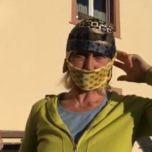
Im Visier Krawattenhut mit integrierter Maske!

Inga Rosa Kammerer works as a freelance actor for theater, film and TV, as well as in theater pedagogy for children and teenagers. She is giving different theater classes at MiK Jugendkunstschule in Berlin Mitte.

Shí Kollectiv

Artist Collective

View contribution on Instagram, Facebook and Youtube

Lina Launhardt was planning a performance for 02.05. in the framework of the current exhibition at Bärenzwinger.

Jasmin Werner

Artist

View contribution on Instagram, Facebook and Youtube

A video by Jasmin Werner relating to her work ‘Schloss der Republik Burj Khalifa’.

For »Musée sentimental de l’ours de Berlin« Jasmin Werner developed two installations at the outside area of Bärenzwinger which resemble scaffolding and refer to the history around the Berlin Stadtschloss.
In the visual part of the works different reflections of windows from Stadtschloss and Palast der Republik are merged, episodically telling the story of a changing city between political systems. Transformations Bärenzwinger as a monument for this city has also witnessed, but which didn’t affect it as drastically so far.

The shape of the two towers is inspired by the worlds highest building – Burj Khalifa in Dubai – whose steel structure was partly built with steel from the Palast der Republik.

Nadja Abt

Artist and Editior

View contribution on Instagram

Alternative Embassy of Brazil
project proposal for the Bärenzwinger, Berlin

Only a few meters away from the Bärenzwinger is the Brazilian Embassy of Berlin. In times when Brazil’s government is trampling on the country’s human rights and democracy, the
alternative embassy serves as a place of refuge and a space where resistance can be organised in artistic and activist ways.

Nadja Abt is an artist and works as the editor for Texte zur Kunst. From 2015-2018 she lived in São Paulo. For her collages, films, and paintings, she uses literature as a starting point to
create formal and textual layers that engage with Brazilian politics and art history, feminist discourses, and the maritime space. We want to work with her in spring 2021 within the
»Openings, not Openings« programme.


Theres Laux

Eventkauffrau,
Museologist (MA)

View contribution on Instagram

Under the synonym ArtPlanner Theres Laux is responsible for the organization of a variety of different cultural and economic events. All planned events, in which people meet face to face, had to be cancelled or postponed. By now some interesting digital alternatives were created, so that cultural education, entertainment and the information flow on products can be continued in virtual space. temporarily, only for a short time period; as it is better to see people being together, carefree, and see them smiling. 

Andrea Scrima

Writer and Artist

View contribution on Instagram, Facebook and Youtube

Corona Report

Recording from Dona Blum during the Viral literature festival. Conversation Series with Authors and Artists, 3 Quarks Daily

https://www.3quarksdaily.com/3quarksdaily/author/andreasrima

Andrea Scrima translates and works as a lecturer for the Kommunale Galerien in Mitte.

Eunsun Ko

Artist

View contribution on Instagram and Facebook.

picture 1, 2, 3, 4, 5, 6

Drawings in my apartment on the kitchewall by me and three roommates (professions: computer scientist, app-developer, architect)

picture 5
How does the world currently look like?
Watercolor and collage on paper

Eunsun Ko is an artist. Her focus lays on sculptures, drawings, installations and texts. She lives
and works in Berlin and is giving workshops and courses for art projects. Since 2015 she’s working as an art teacher for MiK – Jugendkunstschule Mitte.


Katja Stoye-Cetin

Artist

View contribution on Instagram and Facebook.

Geist 2.2.

Katja Soye-Cetin works as an Artist in Berlin. She’s mainly working with photography. At the an artist book is in the making.

Robert Günther

Artist and Cartoonist

View contribution on Instagram and Facebook.

Depicted are the first 6 pages of the comic „Wa(h)nsee”, a 24-page comic book.The black and white drawings were made during the 24h comic-event of Literarisches Colloquium Berlin last October. In 24 hours 24 comic-pages are being drawn and written, forming a complete story. During the last two months Robert Günther edited and colored the pages digitally. The drawing’s and story’s mood fits well into this time of isolation and distancing rules.

The finished book will be published in the end of September with JUTE COMICS Verlag. Robert Günther is an artist and cartoonist. His main focus is drawing and print graphics. After graduating as a Meisterschüler at Berlin University of Arts he worked as a teacher for fine arts and, since 2017, is part of the management team of MiK Jugendkunstschule Mitte


Heather Purcell

Artist

View contribution on Instagram and Facebook

Heather Purcell works as a freelance art educator and gives film- theater- and media-workshops in museums, schools and at MiK Jugendkunstschule Mitte. Furthermore she  works on numerous projects as a performance-artist.

hugo rex tibiriçá

Artist

View contribution on Instagram and Facebook

hugo rex tibiriçá (prefer no pronouns) is a queer artist born and raised in brazil. as far as hugo knows, hugo descends from the ones who colonized as much as from the ones who have been colonized – from european people as well as middle-eastern, amerindian and african people. therefore, hugo carries within hugo’s-self the heritage of the ones who brutalized as well as the ones who have been brutalized – by the processes of colonization, catechization and the legacies of it -, and tries to embody all the contradictions of such heritage within the self through doing art, practicing somatic work and reading books as well as through loving and feeling loved, living life and quarantining.

Torben Jost

Artist

View contribution on Instagram and Facebook.

Screenshots from videoproject „Intimacies and Isolation“

What does lockdown mean for queer identities, which even before had to to be expressed secluded from mainstream society? At what point does longing for closeness turn into a competition for attention? How infectious is the webcam’s gaze?

In his performances and media-installations Torben Jost addresses discursive entanglements of media- and everyday-objects. Using context-shifts and pop his works uncover hidden meanings and power structures. In this he is especially interested in questions of identity and intimacy. „Intimacies and Isolation” was made in cooperation with The Queer Archive Athens.

Khansa Humeidan

Artist and art educator

View contribution on Instagram and Facebook.

Khansa Humeidan is an artist and art educator. In her work she focuses on art eductation or artistic work in groups in different institutions. Exemplary of that is her development of art eductation formats like peformative audio guides for the Staatliche Museen zu Berlin.

Mariana Nobre Vieira

Artist

View contribution on Instagram and Facebook.

Mariana Nobre Vieira (*1989 in Coimbra, Portugal) is a former economic scientist, who started practicing contemporary dance in 2013. She is founding member of the artist collective „The Rabbit Hole”, in which she intensely influenced the club- and art-scene of Lissabon. She visited the masters course SODA (Solo, Dance, Authorship) at HTZ/UDK Berlin and recently graduated. Now she’s working as a performer, teacher and choreographer. Since 2019 Mariana is member of the  Berlin-based queer-feminist collective for interventions in rave-culture and gender disorientation „Lecken”.  https://mariananobrev.cargo.site

Experimentelles Zukunftslabor

View contribution on Instagram and Facebook.

Between April and June the Berliner Kunstverein Experimentelles Zukunftslabor experimented with different forms of creative and peaceful protest in in times of constantly changing social-distancing rules. How do we manage these new challenges as a society? How can we, despite restrictions, interact in public?

The artists and activists of the Verein staged three peaceful actions in public space in Berlin, in which they, while observing current health regulations,  artistically expressed their sorrows and wishes for a (post-)pandemic reality.


More infos on the actions: http://experimentelles-zukunftslabor.de/present

Diversity Arts Culture

View contribution on Instagram and Facebook.

Diversity Arts Culture is the concept- and advisory body for diversity-development in the arts.

Commissioned by Senatsverwaltung für Kultur und Europa, Diversity Arts Culture works on a sustainable diversity-oriented opening of the Berlin art-scene since 2017.

Diana Bach

View contribution on Instagram Youtube, and Facebook.

Diana Bach works in the Fachbereich Kunst, Kultur und Geschichte des Bezirksamts Mitte.
There she is advising and supervising cultural workers in their work on funded projects. Due to the pandemic every project is now getting reviewed and if possible adapted to the new situation. This time is characterized by an oscillating between different emotional states.

Çiğdem Inan und Katja Diefenbach

View contribution on Instagram and Facebook.

This is how impossible pictures and texts work on the possibility of the struggles.
Hanau was not an Einzelfall (isolated case).

Çiğdem Inan (sociologist) and Katja Diefenbach (cultural studies) are part of the bookstore- and publishing-collective b_books.


b_books is a collective consisting of theorists, activists, artists and filmmakers. Founded in 1996 in Berlin Kreuzberg as a bookstore and venue (montagsPraxis) it later also started publishing and producing films. http://www.b-books.de

Beatrix Joyce

View contribution on Instagram and Facebook.

dis[ ]tanz podcast
a podcast on the future of dance and performance

Berlin-based performance artist and dance writer Beatrix Joyce explores how digitalisation changes the way we create, experience and engage with dance and performance. Together with invited guests, she delves into the new utopian possibilities that the performing arts may have gained with increased virtual inter-connectivity while also looking at what live art forms may have to lose.
The guest speaker in the first episode, of which this clip is taken from, is Martina Ruhsam.
Website: beatrixjoyce.com

Encoded Earth Lover

View contribution on Instagram and Facebook.

Encoded Earth Lover is a visual artist, musician and immigrant from Belarus. The objective of her art practises lies in her own interest in trance states that cultivate healing in one’s body, mind and spirit. Her visual and musical explorations are textural journeys that try to achieve illusory timelessness while relaying messages of ascended futures.

Pirate Cinema Berlin

View contribution on Instagram, Facebook, Youtube.

Watch Pirate Cinema Berlin Burn 50 Euros brutto Live on Twitch, followed by Serge Gainsbourg brûle un billet de 500 francs à la télévision and Watch the K Foundation Burn a Million Quid

Q: Why?
A: Because we’re cheap.

Q: Making of? Deleted scenes? Commentary track? Director’s cut? English subs?
A: Yes, eventually.


Ariane Müller

View contribution on Instagram and Facebook.

Mall of Berlin in Ruins

Oh, these beautiful, sublime ruins! What effect! What greatness! What nobleness! […] With which wonder, which surprise I gaze at these broken vaults […] the people, who built these monuments, where are they? What became of them? In what vast, deep and silent depth does my eye lose itself? […] Time stands still to those who admire. How little I have experienced! how briefly my youth lasted.”
from Denis Diderot, Ruines et paysages. Salon de 1767
about Hubert Roberts Bilder der Grande Galérie des Louvre als Ruine

Florian Zeyfang

Künstler

View contribution on Instagram and Facebook.

Rechteckskritzeleien

Since March Florian Zeyfang is waiting to start shooting the film „La Escuela Nueva” in Kuba, which he planned together with Lisa Schmidt-Colinet and Alexander Schmoeger. Until then he works on the postproduction of „Pavilion-In-Parts”, on the program for the next semester in Aarhus/Denmark – who knows if he can travel there – and converses over the usual video- and audiochannels.


Elis Ottosson

View contribution on Instagram and Facebook.

In absence of studio and away from the loom weaving didn’t stop. New restraints, of format and time, where formed. Sketches and doodles. A memo, a problem, a solution and a praise.

A sort of diary. Wordless thoughts visualised in the poetry of the thread.

For a digital documentation, needed especially in covid-times, I choose to scan my pieces. Something happens in the action of scanning versus taking a photo of my woven work. When scanning the objects the information is read and transformed, line by line. Like a text. Like woven cloth.

Carolina Redondo

View contribution on Instagram, Facebook and Youtube

Replay

I descend further and further
Far beyond the borders
Escape or Access?
Both
The sky and the south are below
I plant myself in the basement
Because everything that grows, comes from below

Carolina Redondo is artist and head of production at Klosterruine Berlin and Bärenzwinger. In her works she translates existential conditions into photographic images, videos and installations.


Heike Nowotnik

View contribution on Instagram, Facebook and Youtube

see’in see’nothing
Video 3’29 min

Heike Nowotnik is a freelancing Berlin based artist and works with video, installation and drawing. She is co-founder of KU+R Kunst und Raum and is teaching young adults in the Werkstatt für bildende Kunst in ExRotaprint Gelände Berlin Wedding.

‘see’in see’nothing’ shows a row of windows in Berlin Mitte, that for the artist took on exhibition character in times of lockdown. Her view always focuses on the same windows in a specific part of the street and repeatedly tries to gain a deeper insight through the windows into the space.
First with the bare eye and then assisted by a camera. Different times of day and incidences of light allowed for different „stagings”, that played on the window, became visible and stayed opaque. The curiosity for what might happen behind the windowpane and for what the window shows and hides, creates an intense tension while viewing – especially while looking at the resulting photos that are the base for this video.

Marco Clausen

View contribution on Instagram, Facebook.

Architectures of Amnesia, Architectures of Domination


Marco Clausen is a trained historian, he co-founded Prinzessinnengarten in 2009. He’s working towards socio-economic change on a local and global level, works on self-organized political education programs, among others with the project „kollektives lernen“, and is active against gentrification and privatization.

Michela Filzi & Lea Pischke

View contribution on Instagram and Facebook.

Social Distancing, 2020

A globally shared situation where proximity is a threat, distance is safety. Obsessive hand washing and incessantly monitoring one’s own gestures – “Have I touched my face, nose or mouth?”, “What have I touched before that?”.
Under such circumstances, performance artist Michela Filzi and dancer/choreographer Lea Pischke defy current mobility hardship and move together into a flat in April 2020. They start sharing not only the household, but also their concern about the lack of physical contact: its removal from social dealings on the one hand, and its absence as a performative act on the other.
What has happened to dance during the lockdown? How is dancing being re-defined by having both its place of action and its bodies taken away from it? How does the body react to fear, to re-framing the other as an intruder in one’s own physical integrity? Where are we?
The online world has become the new sanctuary of social togetherness, the virtual condom for potentially infectious liaisons.
The videos here are excerpts of movement improvisations on the theme of social distancing and fear of contagion.


Esra Nagel & Misal Adnan Yildiz

View contribution on Instagram and Facebook.

Fiktionsbescheinigung

T Shirt print editions, 3 copies designed by Esra Nagel 2020

This work has a short story… We talk a lot with no expectations. Friendships rely on an ongoing interest in wishing the best for the other. In 2018 we first worked together on the exhibition “conlang”; it was part of the Seen by… exhibition series by UdK, Berlin. We installed Esra’s work together for that show at the Museum für Fotografie in Berlin as mission impossible is still an unforgettable memory. We became friends later and caught up from time to time. This work has also arrived to us on the basis of our friendship and ongoing conversations. Both of us sometimes feel like we are part of an ongoing fiction that we share with others. Feeling in and out of the social categorization of things.Misal has been feeling like a fictive character with ‘Fiktionsbescheinigung’ provided by the German state as an earlier promise for a forthcoming visa extension. It is still not a clear document that grants one a visa extension or a residence permit. You are neither a guest nor a resident. Your status is pending in limbo.Through his experience of living this reality, Misal has been trying to understand the precarious lives of the undocumented citizens, refugees, exiles, migrants among others who have to live with the pressure of policing, status quo and state control. This summer, driven by the COVID-19 pandemic, the Auslanderbehörde has achieved a Kafkaesque cinematic quality and Misal says: “I am fiction, and I have Fiktionsbescheinigung” reflecting the kaleidoscopic patterns Esra designed through the file anyone can access on Wikipedia. We suggest you google this word ‘Fiktionsbescheinigung’! if you live in Germany. Your search might tell you how the state invents its own language in the case of ordering, controlling, including by excluding, and excluding by including… transitionally yours…/

Museé sentimental de l’ours de Berlin

Nschotschi Haslinger
Sathit Sattarasart
Anna Virnich
Jasmin Werner

Nschotschi Haslinger
Sathit Sattarasart
Anna Virnich
Jasmin Werner

[Foto] Sathit Sattarasart

Opening
02/06/2020 7pm

Exhibition
02/07–06/28/2020

03/05/2020
7–10 pm
Artist Talk
with Nschotschi Haslinger and Anna Virnich


03/18/2020
7–10 pm
TheorieMittwoch
with Philipp Kleinmichel

04/24/2020
7–10 pm
»Der Bärenzwinger zwischen den Staatssystemen (1937-1995)«
by Marie-Christin Krüger

05/01–05/03/2020
Gallery Weekend Special

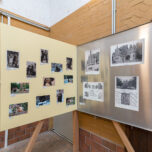
»Musée sentimental de l’ours de Berlin« is an attempt at erecting a temporary museum dedicated to the Berlin Bear. The effort lays no claim to completion or that it follows any particular grand narrative, but rather—entirely in keeping with its role model, Marie-Louise Plessen and Daniel Spoerri’s Musée Sentimental—seeks to link small individual stories with emotional values.

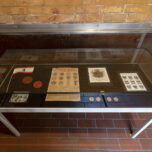
These stories have different points of departure. The various artistic works in the exhibition address the heraldry of the city’s coat of arms and history as well as the bears’ current absence, and are an active contribution to the design of the exhibition displays. In addition to the artistic works, the exhibition also presents a large number of objects and ephemera that delve into the history of the city’s bears in the Zwinger and the representative function they’ve performed for the city over the past 80 years.

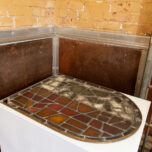
These include a window with the heraldic animal from the Rotes Rathaus, various ways in which the bears have been perceived in children’s books and toys, objects of everyday life from the Zwinger, and physical traces of the bears themselves.

The exhibition’s aim is to develop a special form for approaching the history of the Bärenzwinger that is also closely interwoven with the history of the city of Berlin.

The format emerges from the architecture and history of the location and pursues various paths.

Exhibition & events curated by Jan Tappe and Julia Pomeranzewa

Ulrike Riebel and Hauke Zießler

Graphic Design: Viktor Schmidt
Translation: Andrea Scrima
Production: Carolina Redondo

Download Concept

Nschotschi Haslinger

Nschotschi Haslinger (*1982 in Eitorf) is an artist working at the interface of sculpture and drawing. Recent solo exhibitions include »Der geheime Dienst«, Zero Fold, Cologne, »Die untere Welt«, Overbeckgesellschaft in der St. Petrikirche, Lübeck, »Introesque«, Exile, Vienna (all 2019), »Das gestohlene Lied«, Galerie Genscher, Hamburg, »Apropofola«, Kunstverein Kjubh, Cologne (both 2018). In addition, her works have been shown in numerous group exhibitions including »When the Sick Rule the World«, GR_und, Berlin (2019), »May the Bridges I burn light the Way«, Manifesta 12, Palermo (2018), Simonow Collection, Kunsthalle Bozen, Bolanzo (2016) and »Ruhe-Störung, Streifzüge durch die Welt der Collage«, Marta Herford, Herford (2013). She lives and works in Berlin.

During the preparatory phase of her work, Nschotschi Haslinger delved deeply into the Bärenzwinger’s history and the heraldry of the city coat of arms. This is particularly evident in the poses of the various animals within the group. The artist’s choice of color was comparatively freer and adapted to the spatial situation in the Bärenzwinger’s exhibition rooms. Haslinger takes the bears very seriously as entities and uses the individual figures and the way they’re positioned in space to tell a story of trepidation and to allow viewers to empathize with the bears’ suffering in captivity.

Sathit Sattarasart

Sathit Sattarasart (*1979) is an artist whose works are mostly about how things come to be, while he is focusing on art related subjects, material, process and structure of things, he also works with various subject matters from politic to everyday life scenario. Sattarasart’s works have been included in several international exhibition, among them, Asian Film & Video Art Forum at MMCA, Seoul (2015), Home Stories at KfW Stiftung, Frankfurt am Main (2013), Move on Asia at ZKM, Karlsruhe (2013), Busan Biennale 2006. In 2017, Sathit Sattarasart graduated (Meisterschüler) from Staatliche Hochschule für Bildende Künste from the class of Professor Tobias Rehberger and currently he lives and works between Berlin and Bangkok. In his artistic practice, Sathit Sattarasart pursues various threads ranging from sculpture and installation to his own curatorial projects, all of which share an intensive exploration of the respective location or context in which they are to be later shown.

One of these threads is the »pedestals« series, which consists of pedestals he designs for works by other artists for the purposes of exhibiting them. This can be meant in a very physical sense, but also takes place on a non-material level. For the Bärenzwinger, Sattarasart developed two new »pedestals«. Unlike their predecessors, these are dedicated to two objects that are not works of art. Resting on one is a small sculpture atop a colored sheet of acrylic glass. The sculpture is a model that was made for the purpose of fabricating a taxidermic specimen from Schnute, the last surviving female bear in the kennel. The proportions of the pedestal correspond to the bear’s body size and the relationship to the interior of the cage in which the pedestal is placed. Its position, the distance the viewer needs to stand at to view the work, and its color are references to a sense of privacy that the artist tries to create for the sculpture. The second pedestal is immaterial and incorporates bear fur from the Bärenzwinger’s last two bears, Maxi and Schnute, into a narrative.

Anna Virnich

Anna Virnich (*1984) graduated in 2013 from Braunschweig University of Art, Germany. Recent solo exhibitions took part at Schering Stiftung (2019); Arratia Beer, Berlin; Galerie Nathalie Halgand, Vienna, Art-O-Rama, Marseille (all 2017); Proyectos Monclova, Mexico City (2016). The artist furthermore recently contributed to group exhibitions at Hunt Kastner, Prague (2018), Centre d’Art Contemporaine Chanot, Clamart,France; Proyectos Monclova, Mexico City (both 2017). Anna Virnich lives and works in Berlin.

For her installation, Anna Virnich has worked with various organic materials to create an arrangement of leather, wax, and fragrance, all of which react to the physical absence of the bears. Each of these materials performs a different function. While the leather indicates the bears’ physical dimensions, the wax is the color of skin and exudes a strong sense of vulnerability. Lastly, on an olfactory level, the scent occupies the room which the bears also occupied for a long time, but whose odor has evaporated as far as the human sense of smell is concerned. The choice of fragrance is also based on the location and reflects the type of storytelling about memory that is explored throughout the entire exhibition.

Jasmin Werner

Jasmin Werner (*1987 in Troisdorf) lives and works in Cologne. In 2016 she completed her studies at the Staatliche Hochschule für Bildende Künste Städelschule in Frankfurt am Main. Her works have been shown in solo exhibitions at Kunstverein Braunschweig, Braunschweig (2018), Gillmeier Rech, Berlin (2017), M.I / mi1glissé, Berlin (2016), and RM, Auckland (2014) as well as in group exhibitions at Braunsfelder, Cologne (2018), Saloon, Brussels (2018), and the Folkwang Museum, Essen (2017). In 2017, Jasmin Werner completed a residency at the National Museum of Modern and Contemporary Art, Seoul.

For the »Musée sentimental de l’ours de Berlin«, Jasmin Werner has developed two installations on the outdoor terraces that resemble scaffolding sections and allude to the history of the Berlin City Palace. The visual component of the works contains various reflections in the windows of the City Palace and the Palace of the Republic such that they transcend time to tell the story of a city in transition, caught between political systems, a process the Bärenzwinger also experienced as a city monument, although it was not subjected to the same type of drastic physical change. The shape of the work’s two towers frames a reference to the tallest building in the world—the Burj Khalifa in Dubai—into whose steel structure steel elements from the Palace of the Republic were also incorporated.

Artist talk

03/05/2020 7 – 10 pm

with Nschotschi Haslinger and Anna Virnich

Theorie Mittwoch

03/18/2020 7 – 10 pm

with Philipp Kleinmichel

lecture

04/24/2020 7 – 10 pm
»Der Bärenzwinger zwischen den Staatssystemen (1937-1995)«

by Marie-Christin Krüger

FICTIONAL NATURE

Maximilian Arnold & Ørjan Einarsønn Døsen
Isabella Fürnkäs
Fabian Knecht
Keto Logua

[Foto] Fernando Gutiérrez Juárez

Opening
05/16/2019, 7pm

Welcome
Dr. Ute Müller-Tischler
Head of Department Art and Culture, Bezirksamt Mitte von Berlin


About the exhibition
Evelyn Gregel and Jan Tappe

What is nature? How is it perceived and understood? Which actions result from a particular perspective on nature, and how could they differ?

While the philosophy of idealism postulated »wild« nature as the binary opposite of (human) culture, Alexander von Humboldt developed a holistic understanding of nature during his research travels in the 19th century. He conceived of the earth as a complex organism whose countless elements are all interlinked – and conceived of humans as part of these elements.

At that time, European societies had long since begun harnessing their environment through massive interventions: an ongoing process that has put the planet’s ecological balance in a state of permanent crisis and at the same time opens up various future narratives.

As part of the program »Fictional Odyssey« at Bärenzwinger, the exhibition »Fictional Nature« shows four artistic positions that reflect on human conceptions of nature and the related narratives.

Exhibition & events curated by
Evelyn Gregel, Jan Tappe
Tanja Paskalew, Ulrike Riebel

Graphic Design: Viktor Schmidt
Translation: Saskia Köbschall, Andrea Scrima
Production: Carolina Redondo
Production Assistance: Juan Saez

Download Concept

maximilian arnold & ørjan einarsønn døsen

Over the course of the past year, the two artists, in addition to their respective independent practice as painters, have dared to work together, combining their two approaches and connecting them on different levels. The »Forecast« is a series of over 25 large-format prints depicting weather reports in studio situations and weather maps. The first stage of the printing process is carried out using inkjet printing on stone paper, which partially blurs information on the original screenshot and creates blanks.

Maximilian Arnold studied in Karlsruhe and at the Städelschule in Frankfurt am Main (with Willem de Rooij). His works were last shown at the Museum für Neue Kunst in Nuremberg, the Spazio Buonasera in Turin, the Max Liebermann Haus (Berlin), the Kunsthaus Baselland.

Ørjan Einarsønn Døsen studied in Oslo, Amsterdam and Düsseldorf, where he graduated in 2016. His works were shown a.o. at Fiebach Mieniger (Cologne), Chez Malik (Hamburg), W139 (Amsterdam) and Pantaleons Mühlengasse (Cologne).

Both artists live and work in Berlin. Their joint work is currently also on display at Tor Art Space in Frankfurt am Main.

isabella fürnkäs

In her installations, drawings, sound and video works as well as performances Isabella Fürnkäs discusses topics like isolation, corporeality and communication structures. She combines digital and archaic media, questioning identity, self-awareness and memory. Desire, lust and emotional vulnerability are the main motives of her work.

Isabella Fürnkäs lives in Düsseldorf and Berlin. She studied in Zurich, Vienna, Berlin and Düsseldorf, where she graduated in 2018 as Andreas Gurskys’ master student. Her performances and works have been shown at the Kölnischer Kunstverein, the Kunsthalle Wien, the PS120, the Akademie der Künste der Welt in Cologne and the Pogobar of the KW Institute for Contemporary Art Berlin. She is currently completing the Bronner Residency in Tel Aviv.

fabian knecht

With his works, which often appear unexpectedly in public space, Fabian Knecht breaks out of the exhibition context and into everyday life. He changes patterns of perception and action, transgresses art concepts and power structures, and questions social relations and norms by countering them with strong and provocative images.

Fabian Knecht studied at the Universität der Künste Berlin and at the California Institute of the Arts. In 2014 he completed his master’s degree with Olafur Eliasson, at whose Institut für Raumexperimente he studied from 2009 to 2014. In 2012 he assisted in the studio of Matthew Barney in New York. Fabian Knecht’s works have been shown in national and international institutions and exhibitions, among them the MSU Museum for Contemporary Art (Zagreb), the Moscow International Biennale for Young Art, the Neue Nationalgalerie (Berlin), Hamburger Bahnhof (Berlin), the Imperial War Museum (London), and the Staatliche Kunsthalle Baden-Baden. He is represented by Alexander Levy, Berlin and Christophe Gaillard, Paris.

keto logua

Keto Logua’s sculptures and films often refer to natural phenomena and socio-cultural issues. The artist takes a critical and conceptual approach to found and constructed objects, submitting them to processes of compression and transformation. Examples of this include a 3D print of the world’s first flower, which was reconstructed by a team of scientists last year, or a large sculpture made from elements of a beehive.

Keto Logua studied Painting at the Tbilisi State Academy of Arts and Berlin University of the Arts. In 2017 she was a fellow of the Berlin Program for Artists. Her works have been shown at such venues as KAI 10 | Arthena Foundation (Düsseldorf), Between Bridges Berlin (Berlin), KW Institute for Contemporary Art (Berlin), and the goEast Open Frame Award competition at Museum Wiesbaden. In 2018 she was awarded the ars viva Prize for Visual Arts.

sound performance

06/05/2019, 7 – 10 pm

Víctor Mazón Gardoqui

»Subcutáneo. Towards a meta-natural realism.«

As part of the exhibition »Fictional Nature« at Bärenzwinger, Víctor Mazón Gardoqui presents a specific action for the space, amplifying the invisible by the use of sound as a material capable of sculpting the perceptual space.

Through a series of custom sensors and antennas, the action generates a physical ecosystem of the enormous mass of oscillations and vibrating matter which we inhabit, although we are not able to perceive it, yet which exerts an effect on our bodies. Wavelengths distant to those perceived by our senses, mechanical and electromagnetic oscillations from nature as opposed to those generated by humans (GPS, GSM, WiFi, BT, radar, etc.), indicators of the abrupt transition we are immersed in the exact moment of the performance.

»Nature is not natural and can never be naturalized.«
Graham Harman (2005)

Inhabiting a world in constant oscillation, surrounded by natural phenomena, tectonic changes, drastic fluctuations in pressure, temperature, humidity, periodic alterations by gravitational attraction forces; but also inhabiting a world constantly mutated by the impact of human activity, extraction of raw materials, seascapes soaked in burning oil, floating plastic islands, and an exponential increase of portable wireless interconnected devices.

Our ability to understand the world we inhabit and of which we are part as the reality that surrounds us has become increasingly complex, while we consume doses of reality through digital environments surrounded by information and counter-information in a post-truth era.

The nature that we imagine, that we think we feel or idolize, is a distorted version of the real, transformed by complex cognitive and perceptual processes that make us lose a deeper and perhaps more satisfying form of realism. To reach a deeper realism requires moving away from what we call nature in order to perceive it towards the real, where through its expression it evokes a supernatural state, opposed to the natural or a state beyond it.

Víctor Mazón Gardoqui,
May 2019

workshop

06/29 + 30/2019, 3 – 5pm

Indoor and Outdoor Survival Workshop with Heath Bunting

»Whether you are imprisoned by the empire, avoiding external contaminants, or a desperate parent of multiple babies, you will need to learn survival skills. This workshop can prepare you for emergency situations or just extend your ability to remain indoors and outdoors for long periods.« – Heath Bunting

The British artist Heath Bunting is known for works and projects that break down the separation between art and everyday life, reality and fiction. In the context of the exhibition »Fictional Nature« at Bärenzwinger he gives an Indoor & Outdoor Survival Workshop, which encourages us to reflect the environment, systems and structures in which we live. The aim is to train techniques in order to survive organized life. The workshop will cover topics and elements such as fire, water, food, shelter, sleep, personal hygiene and improvised tools as well as group dynamics and mental health.

Your tutor for this workshop has not only spent the last 2 years in a bedroom with another adult and twin babies for an average 23 hours per day but has also lived in the outdoors for months at a time.

theorie mittwoch

07/10/2019, 7 – 10pm

with
Klara Hobza
Georg Dickmann
Leif Randt

Moderation
Stephan Porombka

Nature isn’t what it used to be. On the one hand, it seems to exist as nothing more than a colonized, altered, aestheticized, economized, transformed, mistreated thing. At the same time, more and more often and increasingly clearly, it shows us a side that is enigmatic, alien, puzzling, ineluctable, and self-determined that operates according to its own laws and wards off any intervention. Impassively, it seems to absorb the traces culture leaves behind and to incorporate these in order to make, in the long term, its own thing out of them.

What appears along the interfaces are the planned and unplanned phenomena of the wondrous hybrids which repeatedly put culture and nature at risk. In the framework of the exhibition program »Fictional Odyssey,« we ask knowledgeable scouts and expedition leaders to tell us where we wind up if we travel along these interfaces and penetrate into the new spatial depths. What do we have to know? How should we prepare? What should we take along? What is there to discover?

Stephan Porombka, professor at the University of the Arts in Berlin, questions artist Klara Hobza, scientist Georg Dickmann, and writer Leif Randt.

TOPO FICTION

07/16–18/2019, 10am – 1pm

Summer Workshop for Schoolchildren with Heather Purcell and Tuna Arkun

Tuna Arkun, born 1968 in Istanbul, studied painting and drawing at the State Academy of Fine Arts in Karlsruhe and the Academy of Fine Arts in Bratislava (Slovakia). He has been working with children, youths, and adults in art and cultural projects since 2005.

Heather Purcell, born 1986 in Glasgow, studied fine arts there (BA) and is currently doing her masters in Art in Context at the University of Fine Arts Berlin. She works as a freelance art educator and runs workshops in film, theater, and media in museums, schools, and at the MiK Jugendkunstschule in Berlin Mitte. She has also realized numerous projects as a performance artist on the independent art scene.

We explore the world of bears and, in the process, create our own book. For over 75 years, bears lived in the Bärenzwinger, a bear pit in which they watched Berlin’s history unfold around them. As they paced back and forth in their small domain, they observed the humans with curiosity. How does the world look to a bear? Lotta the Bear tells us her story and invites us to see Berlin from a bear’s eyes.

In the three-day workshop, we will create our own topofiction. We begin with a visit to the current exhibition “Fictional Nature” and from there discover Lotta’s environment.

Each day begins with a game to warm up our senses before we begin drawing, printing, and researching what we see and can imagine. In the process, we create our own stories and make a picture book out of them. Then we end each day with another game.

WORLDING IT OTHERWISE OR ELSE

Beth Collar
Stephanie Comilang
Magdalena Los
Anna M. Szaflarski

[Foto] Marlene Burz

Opening
02/14/2019, 7pm

Welcome

Dr. Ute Müller-Tischler
Head of Department Art and Culture

About the exhibition
Marie-Christin Lender and
Christopher Weickenmeier

Exhibition
02/15/19 – 05/05/19

03/22/2019, 7pm
Book Launch

″Bärenzwinger Berlin | Traces – Architectures – Projections″


04/10/2019, 7pm
TheoryWednesday

Film Screening »Donna Haraway: Story Telling for Earthly Survival« Fabrizio Terranova
Welcome and Discussion with Isabel de Sena


04/28/2019, 3 + 5pm
Gallery Weekend Special

Performance »Der Prolog Akt 2«
Aran Kleebaur and Liesa Sophie Harzer


»Worlding It Otherwise or Else« explores how artistic work works.

Beyond the material conditions of production, artists may invent their own set of conditions and relations through which their work is rendered working.

And those circumstances are no less real, significant, or material for that matter.

Taking this supposed paradox as a starting point, the group exhibition assembles four artists that each in their own way define laws, narratives, and forces – effectively putting worlds into practice, making things visible that are there and that are not.

Exhibition & events curated by
Marie-Christin Lender,
Christopher Weickenmeier
Evelyn Gregel, Nandita Vasanta

Download Concept

Beth Collar

Beth Collar is an artist working predominantly in performance and sculpture or in the shared ground between them. She was born in Cambridge, England in 1984. Recent solo projects have been at Mathew Gallery, New York; Primary, Nottingham and Matt’s Gallery, London, 2018; Standpoint, London, 2017 and at Fig 2, ICA, London, 2015. Recent group shows and performances have been at Sans Titre, Paris; Cafe Oto, London; Kunstverein München; Kunstraum, London, 2017; Glasgow Women’s Library, Glasgow; Freud Museum, London; KW, Berlin, 2016; Cubitt, London; Rijksakademie, Amsterdam; Raven Row, London; the Serpentine Galleries, London; She was recipient of the Mark Tanner Sculpture Award 2016/17.

Stephanie Comilang

Stephanie Comilang lives and works between Toronto and Berlin. She received her BFA from Ontario College of Art & Design. Her documen-tary-based works create narratives that look at how our understandings of mobility, capital and labour on a global scale are shaped through various cultural and social factors. Her work has been shown at Ghost: 2561 Bangkok Triennale, International Film Festival Rotterdam, Asia Art Archive in America New York, and SALTS Basel.

Magdalena Los

Magdalena Los (*in Jastrzębie-Zdrój, PL) lives and works in Hamburg and Cologne. Her Zodiac sign is pisces, in the dog horoscope after D. R. Otalora she is a dalmatian. In her work she combines objects, performance, editions and text. Her main quality is mutability, which makes her hard to pin down. As a passionate storyteller she likes giving people what they want, but not what they thought they wanted. Her work has been shown in the Kunstverein Hamburg, Kunstverein Harburger Bahnhof, Große Kunstschau Worpswede, and in a lot of spaces under the radar in Germany, Poland, London and Italy.

Anna M. Szaflarski

Anna M. Szaflarski’s works in illustration, narrative writing and sculpture reference themes related to psychedelic, surreal, supernatural, and feminist science fiction that questions the purpose and potential of the female body. In her work she combines objects, performance, editions and text. Her main quality is mutability, which makes her hard to pin down.

Recent projects include exhibitions at the Vernacular Institute in Mexico City, and Ashley Berlin, and publication projects such as her collection of essays in Letters to the Editors (2015). She is currently working on an upcoming collection of texts and illustrations to be published in the summer of 2019 (Bom Dia Boa Tarde Boa Noite & AKV Berlin).